

Blog

Top Truck Showdown: 2024 Toyota Tacoma vs 2024 Chevrolet Colorado

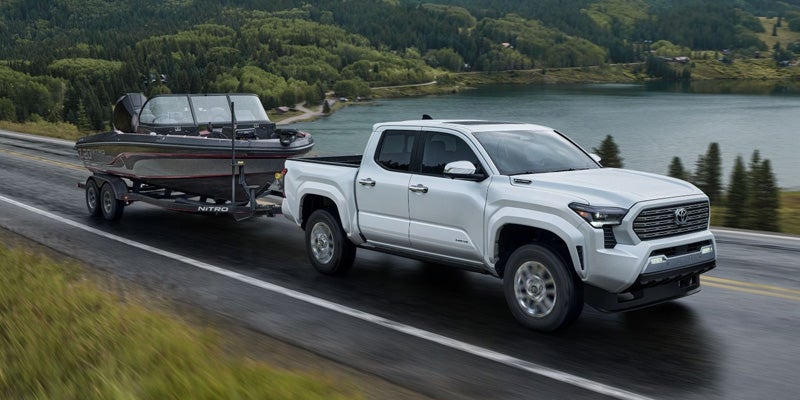
A white Toyota pickup truck tows a boat on a trailer down a road alongside a lake and forest.
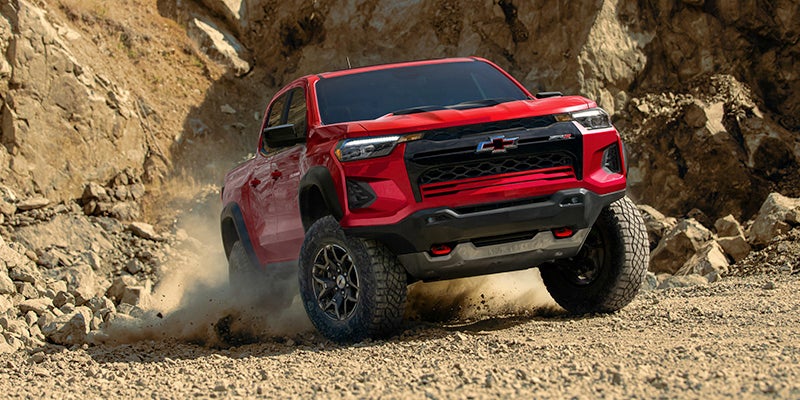
Red Chevrolet Colorado pickup truck kicks up dust while driving over rugged, rocky terrain.

In the bustling city of Katy, TX, where the roads can take you from the heart of Houston to the scenic trails of the Texas countryside, choosing the right vehicle is essential for both work and play. The 2024 Toyota Tacoma and 2024 Chevrolet Colorado emerge as top contenders in the mid-size truck segment, each offering a unique blend of power, agility, and versatility. Whether you're hauling gear for a weekend adventure or navigating the daily commute, these trucks are designed to meet the demands of your active lifestyle.

Top Specs: Toyota Tacoma vs. Chevrolet Colorado
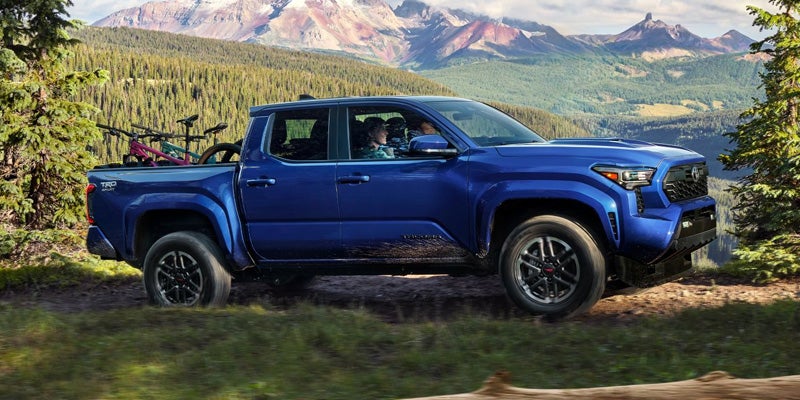
A blue pickup truck with two bicycles in its bed drives on a dirt road through a mountainous, forested landscape.
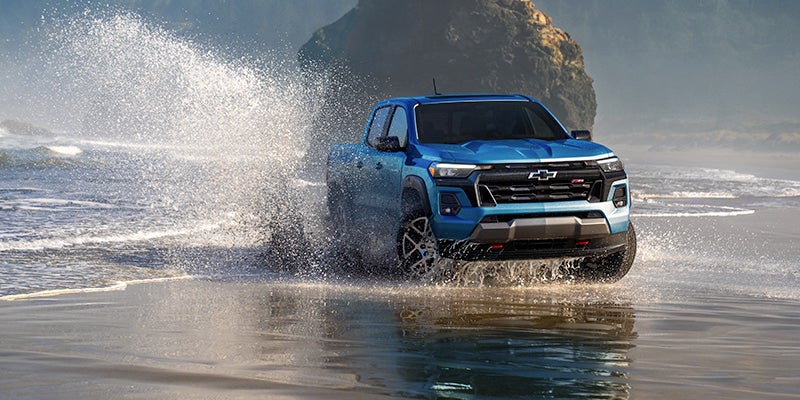
Blue Chevy Colorado ZR2 pickup truck drives through shallow water on a beach, splashing. Remote rocky island in background.

At Toyota of Katy, we understand that choosing the right truck is more than just a decision-it's a lifestyle choice. The 2024 Toyota Tacoma and the 2024 Chevrolet Colorado both bring their A-game, promising to elevate your driving experience across the diverse terrains of Texas.

Feature2024 Toyota Tacoma2024 Chevrolet Colorado
Engine OptionsOffers a 2.4L turbocharged 4-cylinder engine with an available hybrid powertrain, delivering up to 326 horsepower and 465 lb-ft of torque, combining power with eco-efficient performance.Features a 2.7L turbocharged 4-cylinder engine with high-output options, providing up to 310 horsepower and 430 lb-ft of torque, focusing on powerful performance and quick acceleration.
Towing CapacityUp to 6,500 lbs, ideal for a variety of tasks.Up to 7,700 lbs, perfect for heavy-duty jobs.
Off-Road CapabilitiesTRD Pro trim with Multi-Terrain Select and Crawl Control for superior off-roading.ZR2 trim excels in off-road performance with advanced features.
Fuel EfficiencyThe available hybrid achieves an estimated 24 MPG combinedAn estimated fuel efficiency of 20 MPG combined

Power and Performance: 2024 Toyota Tacoma vs. 2024 Chevrolet Colorado
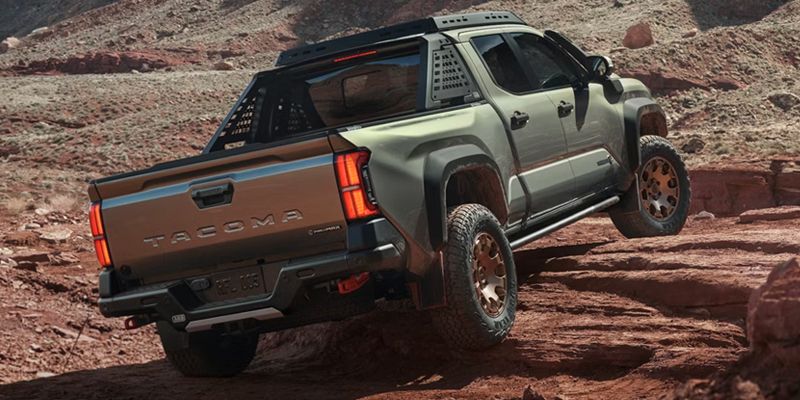
Rear view of an off-road ready olive green Toyota Tacoma truck, with a bed rack, driving on a rocky dirt road.
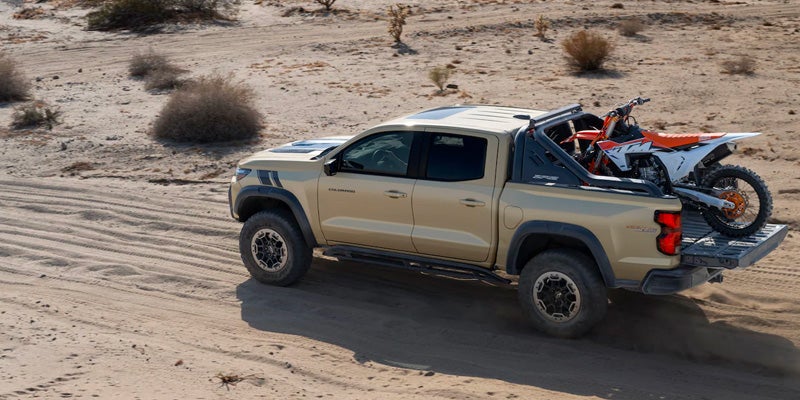
Khaki pickup truck with black trim and roll bar, a white and orange dirt bike in its bed, driving on sand.

In Katy and the surrounding Texas areas, having a truck that delivers both power and precision is essential. Whether you're tackling tough jobs or exploring the great outdoors, the Toyota Tacoma and Chevrolet Colorado are equipped to handle the challenge.

Feature2024 Toyota Tacoma2024 Chevrolet Colorado
Versatile PowerA range of engine options, including a hybrid powertrain, ensures adaptable and robust performance.Impressive torque output guarantees powerful performance and swift acceleration.
Towing ExcellenceWith a towing capacity of up to 6,500 lbs, the Tacoma is equipped to handle your toughest tasks.With a towing capacity of 7,700 lbs, the Colorado is ready for the heaviest loads.
Fuel-Smart DrivingThe hybrid option underscores Toyota’s commitment to combining power with eco-friendly efficiency.Focuses on power, but may not match the Tacoma’s hybrid efficiency.
Off-Road MasteryThe TRD Pro trim offers advanced off-road features like Multi-Terrain Select and Crawl Control.The ZR2 variant is renowned for superior off-road performance.

Interior and Exterior: 2024 Toyota Tacoma vs. 2024 Chevrolet Colorado
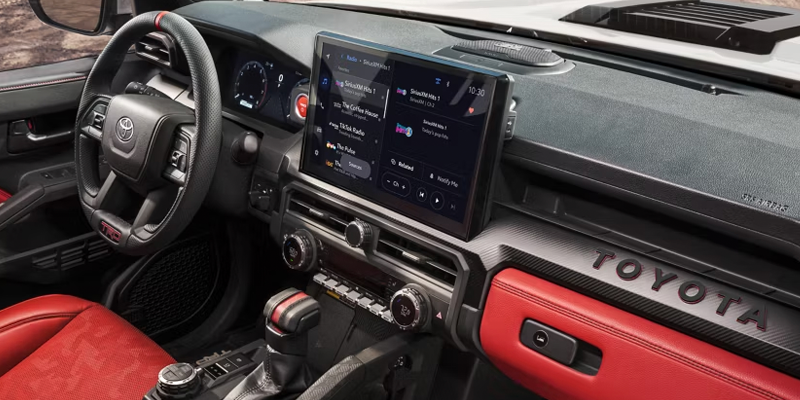
Interior of a car with black and red accents, including a large infotainment screen, steering wheel, and red seats.
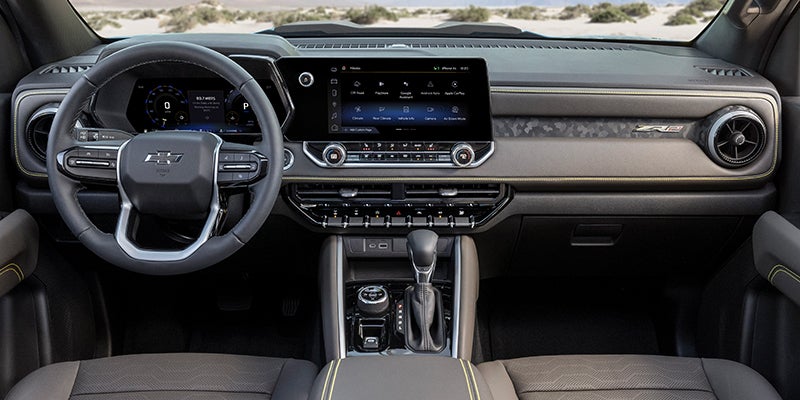
Interior of a Chevrolet pickup truck with a large infotainment screen, digital gauges, yellow accent stitching.

The interior of your truck is more than just a cabin-it's your command center. Both the 2024 Toyota Tacoma and Chevrolet Colorado offer interiors that are designed to keep you comfortable and connected, but each has its unique strengths.

Feature2024 Toyota Tacoma2024 Chevrolet Colorado
Refined CabinHigh-resolution screens and traditional switchgear for a balanced blend of classic and modern.New center console design with front cupholders and updated gauge cluster.
Tech-ForwardDigital gauge display, large touchscreen, wireless smartphone mirroring, and multiple USB-C ports.Features a new infotainment screen and steering wheel for easy access to technology.
Ergonomic DesignEnhanced seating position, added headroom, and an adjustable steering column for optimal driver comfort.Prioritizes driver and passenger comfort with thoughtful interior design and seating ergonomics.
Keyless ConvenienceStandard keyless start and optional digital key via subscription enhance ease of use.Intuitive controls and layout create a user-friendly driving environment.

Don't miss the opportunity to experience the 2024 Toyota Tacoma-visit Toyota of Katy today and see why this truck is the perfect blend of innovation, performance, and reliability, ready to tackle whatever life throws your way

Safety and: 2024 Toyota Tacoma vs. 2024 Chevrolet Colorado
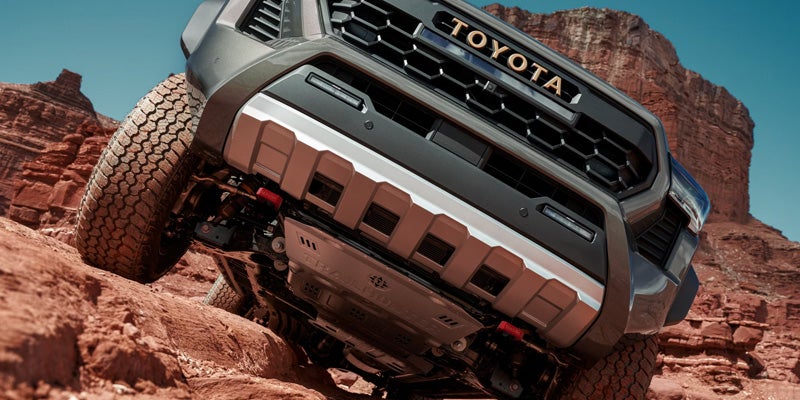
A brown Toyota truck's front end and underside driving up steep red rock terrain, with a mesa in the background.
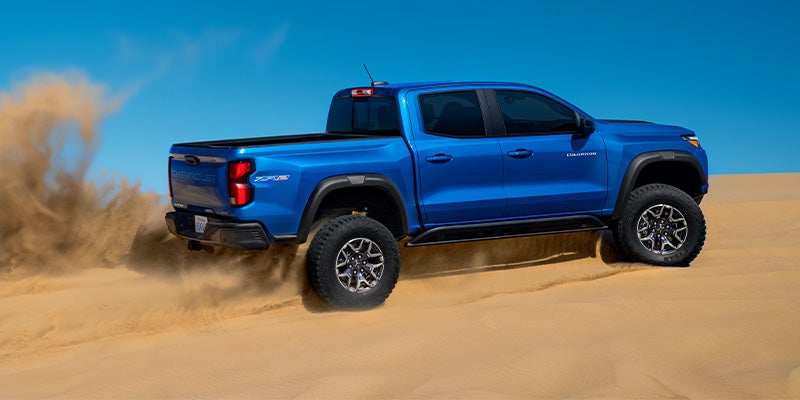
A blue Chevrolet Colorado pickup truck with large off-road tires kicking up sand in a desert dune.

Choosing between the 2024 Toyota Tacoma and Chevrolet Colorado often comes down to their specific strengths in off-road capabilities, towing power, and technological features.

Feature2024 Toyota Tacoma2024 Chevrolet Colorado
Safety FeaturesToyota Safety Senseâ„¢ P (TSS-P)Blind Spot Monitor with Rear Cross-Traffic AlertEight AirbagsCrawl Control and Multi-Terrain Monitor (available on TRD Pro)Chevy Safety AssistLane Change Alert with Side Blind Zone AlertRear Cross Traffic AlertTeen Driver Technology
Towing CapacityCapable of towing up to 6,500 lbs, perfect for both work and recreation.Boasts a higher towing capacity of 7,700 lbs, ideal for heavy-duty tasks.
Tech-Rich CabinIncludes features like a digital gauge display and wireless smartphone mirroring.Offers advanced tech features
Hybrid EfficiencyThe hybrid powertrain enhances fuel efficiencyFocuses on power

The Tacoma's TRD Pro trim and hybrid powertrain set it apart as a versatile, environmentally conscious option, while the Colorado's ZR2 trim excels in off-road prowess. Both trucks offer advanced safety features, but the Tacoma's additional options give it an edge for those who prioritize security.

The 2024 Toyota Tacoma: The Ultimate Choice for Versatility and Innovation

The 2024 Toyota Tacoma available at Toyota of Katy is the premier choice in the mid-size truck segment, offering a blend of robust performance, advanced technology, and environmental consciousness that's hard to beat. With impressive off-road capabilities, substantial towing capacity, and a tech-rich cabin, the Tacoma caters to the adventurous and the practical alike. The addition of a hybrid powertrain highlights Toyota's commitment to fuel efficiency and reduced environmental impact, making the Tacoma the ultimate choice for drivers who demand versatility, innovation, and sustainability.

Visit Toyota of Katy to Experience the 2024 Toyota Tacoma Today
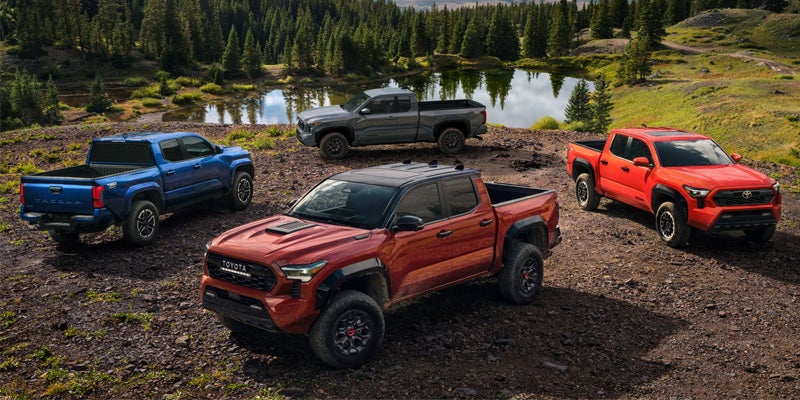
Four Toyota Tacoma pickup trucks (red, orange, blue, and gray) parked on a dirt path overlooking a lake and forest.

At Toyota of Katy, we're more than just a dealership-we're your gateway to a new driving experience. The 2024 Toyota Tacoma, with its dynamic performance, impressive towing capabilities, and commitment to safety and efficiency, is more than just a truck-it's a companion for all of life's adventures.

Our dedicated team is here to provide you with a personalized and seamless car-buying experience. From exploring financing options to selecting the perfect new Toyota vehicle that resonates with your lifestyle, we're here to guide you every step of the way. Visit Toyota of Katy today and discover the 2024 Toyota Tacoma for yourself!

New Toyota | New Toyota Specials | New Tacoma Truck Research | Service Center | Finance Center

Toyota Tacoma Truck Dealership Serving:

Fulshear | Brookshire | Rosenberg | Houston | Cypress | Sugar Land |Richmond |Hockley | Stafford | Waller | Bridgeland
Recommended Posts

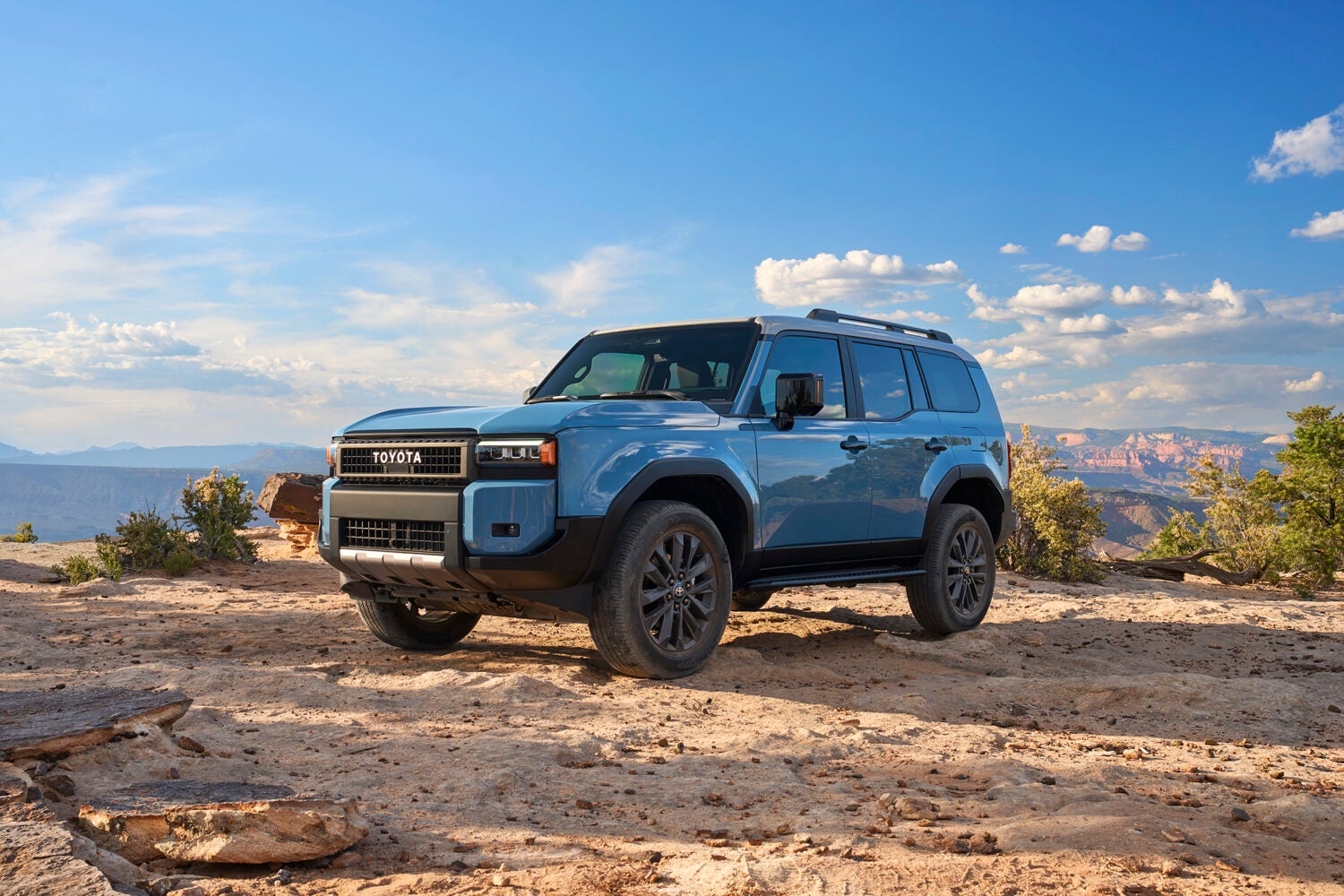
2027 Toyota Land Cruiser Blue

Is the Toyota Land Cruiser a Reliable SUV? Reliability, Maintenance & Ownership

If you're considering a Toyota Land Cruiser, reliability is probably one of the biggest factors in your decision. Known for its off-road heritage and reputation for durability, the Land Cruiser has long appealed to drivers who want an SUV built for the long haul. But how does its modern turbocharged hybrid powertrain fit into that reputation? And what should you expect from maintenance and ownership around Katy, TX? At Toyota of Katy, we help drivers compare Toyota SUVs and understand what it takes to own one. Here's what to know about Toyota Land Cruiser reliability, its hybrid system, maintenance requirements, warranty coverage, and long-term ownership. Is the Toyota Land Cruiser a Reliable SUV? The Toyota Land Cruiser has a longstanding reputation for durability, but reliability ultimately depends on the vehicle's maintenance history, driving conditions, and how well it's cared for. Its body-on-frame construction, proven off-road engineering heritage, and Toyota's experience with hybrid technology make it an interesting option for drivers prioritizing long-term ownership. The modern Land Cruiser also introduces a different powertrain from many of its predecessors. Rather than a traditional V8, it uses Toyota's i-FORCE MAX turbocharged hybrid system. That means buyers should consider both its mechanical capabilities and the additional components that come with hybrid technology. Here are some ownership factors worth considering: Toyota's established reputation for building durable SUVs. A turbocharged hybrid powertrain designed to balance performance and efficiency. Body-on-frame construction and full-time four-wheel drive. Factory warranty coverage for major vehicle components. Scheduled maintenance and hybrid system inspections to support long-term performance. Toyota Land Cruiser Hybrid Powertrain: Is the i-FORCE MAX Dependable? One of the biggest questions prospective owners have concerns the Land Cruiser's hybrid powertrain. Every current-generation Land Cruiser pairs a turbocharged 2.4-liter four-cylinder engine with Toyota's i-FORCE MAX hybrid system. The system places an electric motor between the engine and an eight-speed automatic transmission. Combined output reaches 326 horsepower and 465 lb-ft of torque, giving the Land Cruiser substantial power for highway driving, towing, and off-road situations. What Makes the i-FORCE MAX Different? Unlike a conventional hybrid designed primarily around maximizing fuel economy, the Land Cruiser's i-FORCE MAX system emphasizes torque and performance. The electric motor helps deliver strong low-speed response while working alongside the gasoline engine. Its hybrid components introduce additional technology, including a high-voltage battery, electric motor, and power control electronics. These components are designed to work together, but like any modern powertrain, they require appropriate maintenance and attention to warning lights or changes in performance. Fuel Economy and Everyday Driving The Land Cruiser earns an EPA-estimated 23 MPG combined. For an SUV with standard full-time four-wheel drive and substantial off-road capability, that provides a useful balance between performance and everyday usability. Whether you're commuting along I-10, traveling across the Grand Parkway, or heading out of Katy for a weekend trip, actual fuel economy will depend on traffic, driving habits, weather, and vehicle load. How Long Does a Toyota Land Cruiser Last? The Land Cruiser name has a long history of vehicles reaching high mileage when properly maintained. However, the lifespan of an individual vehicle depends on its service history, driving conditions, and the consistency with which the owner follows Toyota's maintenance recommendations. If you're purchasing a Land Cruiser for long-term ownership, focus on the maintenance schedule rather than assuming any particular mileage is guaranteed. Factors That Affect Land Cruiser Longevity Regular oil changes: Following Toyota's recommended oil and filter service intervals helps protect the engine. Transmission maintenance: Following applicable fluid inspection and service recommendations helps support transmission performance. Cooling system care: Proper cooling system maintenance is important for both engine and hybrid system operation. Tire maintenance: Regular rotations, alignment checks, and proper inflation help maintain handling and even tire wear. Hybrid system inspections: Addressing warning lights and having hybrid components inspected when needed can help identify problems early. For used Land Cruiser shoppers, service records are especially important. A well-maintained vehicle with documented maintenance is generally a better starting point than one with an unknown ownership history. Toyota Land Cruiser Maintenance Costs and Service Requirements Routine maintenance is an important part of keeping any SUV dependable. The Land Cruiser's turbocharged hybrid powertrain and four-wheel-drive hardware make it particularly important to follow the recommended service schedule. What Maintenance Does the Land Cruiser Need? Depending on mileage, driving conditions, and Toyota's maintenance schedule, routine service can include: Engine oil and filter changes. Tire rotations and pressure checks. Brake inspections and fluid checks. Engine air filter and cabin air filter replacement. Cooling system inspections. Four-wheel-drive system inspections. Hybrid system inspections when recommended or needed. Drivers who regularly tow, travel on dusty roads, or take their Land Cruiser off-road may need to pay closer attention to certain components. Always consult the owner's manual for the maintenance requirements that apply to your specific vehicle. Does the Land Cruiser Require Special Hybrid Maintenance? The hybrid system does not require owners to plug in the vehicle or perform separate charging routines. It automatically manages its battery and electric motor operation while driving. However, hybrid components are different from those in a conventional gasoline vehicle. Having technicians familiar with Toyota hybrid systems inspect the vehicle when necessary is important, particularly if a warning light appears or you notice unusual performance. At Toyota of Katy, our service department can help with routine maintenance, oil changes, tire rotations, battery service, and other vehicle care needs. Toyota Land Cruiser Warranty: What Does Toyota Cover? Warranty coverage is another important consideration when evaluating long-term ownership. Toyota provides several layers of factory protection for new Land Cruiser models. Basic warranty: 3 years or 36,000 miles, whichever comes first. Powertrain warranty: 5 years or 60,000 miles, whichever comes first. Hybrid battery warranty: 10 years or 150,000 miles, whichever comes first. Hybrid system component warranty: 8 years or 100,000 miles, whichever comes first, covering qualifying components, including the inverter and hybrid control module. ToyotaCare also covers normal factory-scheduled maintenance for two years or 25,000 miles, whichever comes first, on eligible new Toyota vehicles, along with Roadside Assistance for two years with unlimited mileage, subject to program terms. Confirm the coverage applicable to your specific vehicle and purchase date. These warranties provide additional peace of mind, although warranty coverage should not be confused with a guarantee against mechanical problems. Is the Toyota Land Cruiser a Good Long-Term Investment? The Land Cruiser offers several characteristics that appeal to long-term owners, including Toyota's reputation, four-wheel-drive capability, hybrid technology, and strong name recognition. However, purchase price, depreciation, insurance, fuel, maintenance, and repair expenses all contribute to the total cost of ownership. A vehicle's reputation alone cannot determine whether it will be an economical choice over the years. What About Buying a Used Toyota Land Cruiser? Used Land Cruiser shoppers should look beyond mileage and exterior condition. Maintenance records, accident history, ownership history, and a qualified technician's inspection can help you understand the vehicle's condition before purchasing. Pay particular attention to service documentation and any previous repairs involving the engine, transmission, four-wheel-drive system, or hybrid components. If you're comparing pre-owned Toyota SUVs, you can also explore our used vehicle inventory at Toyota of Katy. Is the Toyota Land Cruiser Worth Buying for Reliability? The Toyota Land Cruiser has a strong heritage of durability, but its modern hybrid powertrain means buyers should evaluate the vehicle as a whole rather than relying entirely on its historical reputation. It's worth considering if you want: A capable SUV with standard full-time four-wheel drive. A hybrid powertrain that combines strong torque with everyday efficiency. A body-on-frame vehicle designed for demanding driving conditions. Factory warranty coverage for major components. A Toyota SUV you intend to maintain according to factory recommendations. Ultimately, the best way to evaluate a Land Cruiser is to consider its features, ownership costs, warranty protection, and maintenance requirements alongside your driving needs. Explore the Toyota Land Cruiser at Toyota of Katy If you're researching Toyota Land Cruiser reliability, our team at Toyota of Katy can help you explore available models, compare features, and learn more about ownership. Visit us at 21555 Katy Freeway, Katy, TX 77450, to see the Land Cruiser in person. You can also browse our new Toyota inventory, explore used vehicles, or contact our team to schedule a test drive. Call Toyota of Katy at 844-809-1063 to get started.

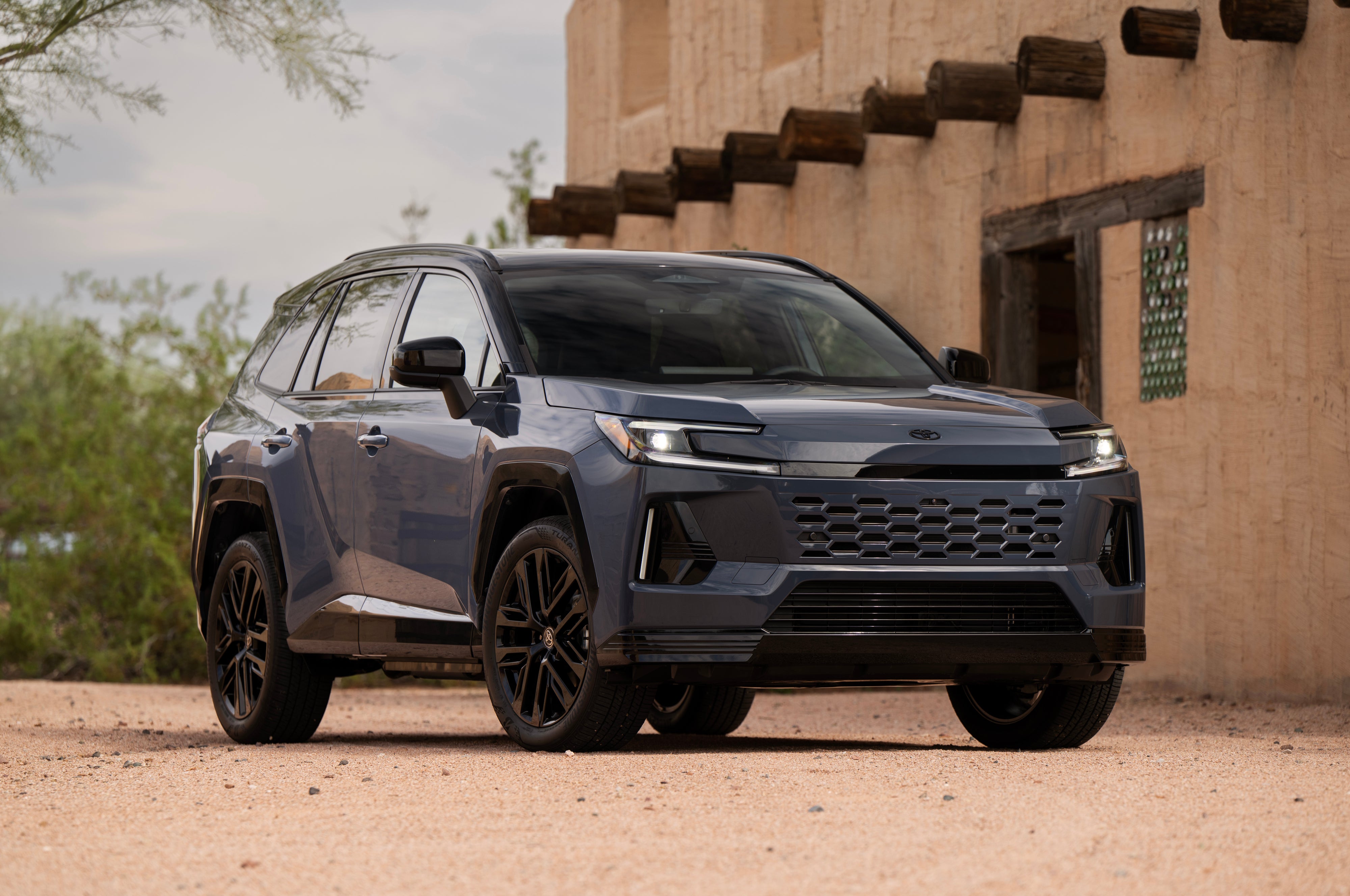
2027 Toyota RAV4 PHEV XSE StormCloud

Toyota RAV4 Hybrid vs. Plug-in Hybrid: Key Differences in MPG, Range & Performance

If you drive I-10 every day or juggle school runs and errands around Katy, the Toyota RAV4 Hybrid vs RAV4 Plug-in Hybrid question comes down to how far you drive and where you park. Cost matters too. Both are efficient, but each is better suited to a different kind of driver. This guide covers the real differences, using 2026 model-year figures. If you'd rather see them in person, you can browse our RAV4 Hybrid and RAV4 Plug-in Hybrid inventory at Toyota of Katy while you read. RAV4 Hybrid vs. RAV4 Plug-in Hybrid: The Core Difference at a Glance Both models pair a gas engine with electric motors. The RAV4 Hybrid recharges itself via the engine and regenerative braking, so it never needs to be plugged in. The RAV4 Plug-in Hybrid carries a much larger battery that you charge from an outlet or charger, which gives it real electric driving. For 2026, the RAV4 is hybrid only, with no gas-only version. Used-car shoppers may see the RAV4 Prime name. Earlier plug-in versions were marketed that way, so today the difference is simply the RAV4 Hybrid versus the RAV4 Plug-in Hybrid. The hybrid comes in LE, SE, XLE Premium, Woodland, XSE, and Limited grades, and now offers FWD for the first time, with AWD available as well. Every plug-in trim (SE, XSE, Woodland and GR SPORT) has standard AWD. Quick Comparison Table: Powertrain, Electric Range, Power, MPG, and Price Figures are EPA or manufacturer estimates and vary with driving, temperature, and charging. RAV4 Hybrid RAV4 Plug-in Hybrid Powertrain 2.5L four-cylinder, two motor-generators; AWD models add a rear electric motor 2.5L four-cylinder, two electric motors including a dedicated rear motor, high-capacity traction battery Drivetrain FWD or AWD Standard AWD Net combined horsepower 226 hp (FWD), 236 hp (AWD) 324 hp Electric range No rated electric-only range (EV mode for short, low-speed distances) Up to 52 miles (Woodland 49, GR SPORT 48) Fuel economy Up to 44 MPG combined (FWD) 40 MPG / 101 MPGe combined (SE) Cargo volume Up to 37.8 cu. ft.; 70.4 cu. ft. with rear seat folded 33.6 cu. ft. behind rear seats; 63.5 cu. ft. folded Price Lower upfront cost Higher upfront cost than the hybrid Electric Range and Fuel Economy: Which Saves More in Your Daily Driving? Start with how many miles you drive between charging stops rather than the highest MPG. A driver whose daily mileage fits within the electric range, and who can charge at home or work, can meaningfully cut fuel use. If you can't charge regularly, the plug-in's advantage shrinks. Here are the efficiency figures side by side. The RAV4 Hybrid LE is rated 47 city and 40 highway. The AWD XLE gets 41 MPG combined, and the AWD Woodland gets 38. The plug-in SE is rated 40 MPG and 101 MPGe combined, and the GR SPORT gets 37 MPG combined. MPG measures gasoline efficiency, while MPGe expresses energy efficiency on an equivalent basis. Neither number alone sets your real operating cost, so run your own mileage. Short Commutes Around Katy and West Houston Picture your whole day, including the return leg. A school drop-off, a grocery run, an errand across Katy, and the drive home all add up. If that loop fits inside the plug-in's range and you recharge each night, much of it can run on electricity. Treat range as an estimate. Highway speed, air conditioning use, weather, driving style, and load all change how far a charge lasts. In Texas summers, expect the A/C to matter. Long Highway Drives and Road-Trip Flexibility Once the plug-in's battery is depleted, it runs as a gas-electric hybrid. Long drives aren't limited by electric range, and you don't have to stop to charge. Both models refuel at a gas station like any other vehicle. On a road trip, the two behave similarly. The plug-in's electric miles trim gas use early in the trip, but its overall advantage depends on how often you charge compared with your total mileage. The hybrid never needs charging equipment at all. Power and Driving Feel: What the Plug-in Adds The plug-in's 324 hp compares with 226 hp for the FWD hybrid and 236 hp for the AWD hybrid. Its electric drive motor produces 203 hp and 201 lb-ft of torque, and Toyota lists 0-60 mph in 5.4 seconds. You'll notice the gap most when merging onto I-10, passing on the highway, or accelerating with passengers and cargo aboard. At low speeds on electric power, the plug-in is also quiet and responsive. The hybrid still gets electric-motor assistance and delivers plenty for economical daily driving. More horsepower doesn't mean better fuel economy, and plenty of buyers won't use the extra power. Our advice: drive both back-to-back. Pay attention to accelerator response and how smoothly the engine kicks in, then compare ride comfort and cabin noise. Horsepower alone shouldn't make the call. Charging the RAV4 Plug-in Hybrid: Home Setup, Speed, and Cost A plug-in pays off when charging is easy and repeatable. The battery is 22.7 kWh, and every grade includes a dual-voltage cable for 120V and 240V outlets. Where you park matters about as much as how far you drive. If you're weighing a plug-in, see our new RAV4 Plug-in Hybrid models and bring your parking situation to the conversation. We can help you think through whether it fits. Level 1 vs. Level 2 Charging Times Level 1 means the included cable plugged into a standard 120V household outlet. It's slow, though fine for overnight top-ups, and for shorter daily commutes it's often enough. Level 2 requires 240V equipment, and charging goes much faster. The onboard charger is 7 kW on the SE and GR SPORT and 11 kW on the XSE and Woodland. On Level 2, a full charge takes about 3.5 hours on the SE and GR SPORT and about 2.5 hours on the XSE and Woodland. Only the XSE and Woodland add DC fast charging, with about 30 minutes to charge from 10% to 80% under ideal conditions. A home Level 2 setup can involve an electrical assessment, equipment, and permitted installation, so have a qualified electrician review your plan. Estimate costs from your actual electricity plan. Can You Own a Plug-in Without a Home Charger? Yes, but think it through. If you rent, own a townhome, or live under an HOA, you can use a standard household outlet, charge at work, or use public stations. Check access, pricing, and the time each option takes. Without external charging, the plug-in runs like a conventional hybrid but loses its full electric benefit. You'd be paying a premium for capability you rarely use. If dependable charging doesn't fit your routine, the hybrid is usually the better match. Price, Incentives, and Long-Term Cost of Ownership The hybrid generally costs less up front. The plug-in costs more because of its larger battery, extra power, and electric driving. We recommend comparing similarly equipped trims rather than just the lowest advertised prices, and asking for an out-the-door figure that includes fees, taxes, and any financing costs. If you plan to finance, our financing application is a good place to start. Upfront Price Gap and Fuel Savings Break-Even A simple break-even divides the plug-in's net price premium by your estimated annual operating savings. Those savings depend on your annual mileage, how many miles you drive on electricity, your access to charging, and local gas and electricity costs. If savings are small, fuel alone may not recover the premium. Money isn't the only measure of value. Some buyers like quieter electric driving and stronger acceleration, and fewer gas stops appeal to them even when payback is long. Insurance and maintenance costs also belong in the comparison, along with resale value, though none of these are guaranteed. Tax Credits, Rebates, and Current Availability According to the IRS, the federal New Clean Vehicle Credit is not available for vehicles acquired after Sept. 30, 2025. Texas administers the TCEQ Light-Duty Motor Vehicle Purchase or Lease Incentive Program (LDPLIP), a grant program for eligible electric-drive vehicles, including plug-in hybrids. Vehicles must be on the TCEQ Eligible Vehicle List, applicants commit to operating and registering in Texas for at least one year, and grants are first-come, first-served. The program's funding appears to be depleted, and no reopening date has been announced. All of this is subject to change and eligibility. Please verify with a tax professional before you count on any incentive. We can't promise one. Toyota lists both the 2026 RAV4 and RAV4 Plug-in Hybrid for our area, but inventory changes. Contact us for current availability. Cargo Space, Features, and Battery Warranty: What Stays the Same and What Doesn't Both models fill the same compact-SUV role. All 2026 RAV4s have a 12.3-inch instrument panel and Toyota Safety Sense 4.0, and a 1500W rear cargo outlet is available. Features still vary by trim, so match trims when you compare. Cargo is where they differ. The plug-in offers 33.6 cu. ft. behind the rear seats and 63.5 cu. ft. folded, slightly less than the hybrid's 37.8 and 70.4. Check the load floor in person with your own gear, whether that's a stroller or a set of golf clubs. Both models carry the same battery coverage: the hybrid battery is warranted for 10 years or 150,000 miles, whichever comes first, and other hybrid system components (such as the hybrid control module and inverter) are covered for 8 years or 100,000 miles, with coverage transferring to future owners. Both share hybrid technology, so routine upkeep is similar, and our Service Center can help keep either one running well. Which RAV4 Fits Your Driving Needs? Neither model is the right answer for everyone. Pick the powertrain whose strengths you'll use every week. Base your decision on a typical week, since your shortest commute or an occasional road trip will mislead you. Choose the RAV4 Hybrid If… You can't reliably charge at home or work, such as in an apartment or an HOA community. Most of your driving is long highway miles beyond the plug-in's electric range. A lower upfront cost matters more to you than electric driving. You want a vehicle that never needs charging equipment. You want the available FWD configuration or the larger cargo volume. Choose the RAV4 Plug-in Hybrid If… You can plug in nightly, and your daily school runs and errands fit within the electric range. You value the extra power for merging and passing on I-10. You want standard AWD on every trim. You accept a higher upfront cost and understand savings depend on how often you charge. You're comfortable with the tradeoff that without charging, it behaves like a conventional hybrid. Frequently Asked Questions Is the Toyota RAV4 Hybrid a plug-in? No. The RAV4 Hybrid never plugs in. It recharges through the engine and regenerative braking. Does the RAV4 Plug-in Hybrid need a home charger? No. The included cable works with a standard 120V outlet. A Level 2 setup is faster, but it isn't required. Which is better for long drives? Both handle them well. The plug-in switches to hybrid operation once its battery is depleted, so you don't need to stop for charging. What happens when the plug-in's battery is depleted? It runs as a gas-electric hybrid. The engine and motors work together, as they do in the RAV4 Hybrid. Does the 2026 RAV4 come in a gas-only version? No. The 2026 RAV4 is hybrid only. Compare Available RAV4 Models at Toyota of Katy We've served the Katy community for over 20 years and sell new and used Toyota cars, trucks, and SUVs, with financing, service, genuine parts, and collision repair. The choice between the Toyota RAV4 Hybrid and RAV4 Plug-in Hybrid is easiest when both are in front of you. Compare current RAV4 models, drive them back-to-back, and bring your daily mileage and charging access, plus your budget. Ask for a clear estimate that separates vehicle price, financing, and any charging costs. Confirm the current inventory with us rather than assuming every trim is in stock. Ready to get started? Contact us online or call sales at 844-809-1063 to set up a test drive.

White Toyota Corolla taillight

Best Toyota Corolla Years to Buy Used

Shopping for the best used Toyota Corolla years comes down to your budget, the safety features you want, and the condition of the specific car. No single year wins for everyone. We'll walk through each generation so you can build a shortlist, then browse the used Corolla inventory at Toyota of Katy when you're ready. Best Used Toyota Corolla Years at a Glance Think of these as shopping groupings. They're not independent reliability rankings, and each one depends on the individual car's history and condition. Top Picks by Budget and Priority If you have a tight budget, look at 2003–2013 (9th and 10th generations), and inspect carefully. If safety technology matters most, consider 2017–2019 sedans (11th generation), which have standard forward collision warning and automatic emergency braking. The 2020 Corolla sedan adds Toyota Safety Sense 2.0 as standard equipment. For the newest used option, go with 2020 and newer (12th generation), which includes the Corolla Hybrid. If you're weighing a newer car, you can also compare new Toyota Corolla models. How We Evaluate Corolla Model Years We look at five factors: reliability record, safety equipment, fuel economy, technology, and ownership costs. On the first and last points, the Corolla starts strong: RepairPal rates it 4.5 out of 5.0 for reliability, first among 36 compact cars, with an average annual repair cost of $362. We don’t use a scoring system or claim internal testing. A model-year recommendation never replaces an assessment of the actual car. Keep comparisons to U.S. sedans, since hatchbacks, the GR Corolla, and the Corolla Cross are separate purchases. Used Toyota Corolla Generations Compared Corolla generation years in the U.S. run 2020 onward (12th), 2014–2019 (11th), 2009–2013 (10th), and 2003–2008 (9th). This table shows how Corolla models differ by year. Generation and years Powertrain Transmission Key safety or tech Fuel economy 12th, 2020 onward (figures shown are for the 2020 sedan) 1.8-liter (L, LE, XLE), 2.0-liter Dynamic Force, 169 hp (SE, XSE), Corolla Hybrid 1.8-liter, 121 hp CVT, six-speed manual Toyota Safety Sense 2.0, eight airbags, backup camera 2020 Hybrid 52 mpg combined, verify by trim 11th, 2014–2019 (engine, transmission, and equipment details shown are for 2014 unless noted) 1.8-liter, 132 hp. LE Eco 1.8-liter Valvematic, 140 hp Six-speed manual (L, S in 2014), automatic Eight airbags, Bluetooth. Forward collision warning and automatic emergency braking standard in 2017 LE Eco above 40 mpg highway (2014 estimate), verify by trim 10th, 2009–2013 1.8-liter, 132 hp; XRS 2.4-liter, 158 hp Five-speed manual; four-speed automatic (1.8-liter) or five-speed automatic (2.4-liter) Antilock brakes standard; verify by trim 1.8-liter 27 city / 35 highway mpg; verify by trim 9th, 2003–2008 1.8-liter, 130 hp; XRS (2005–2006) 1.8-liter, 170 hp Five-speed manual or four-speed automatic; XRS six-speed manual Verify by trim About 26 city / 35 highway / 29 combined mpg (revised EPA); verify by trim 12th Generation Corolla The 2020 redesign brought Toyota New Global Architecture, a new chassis, and a multi-link rear suspension that replaced the torsion-beam setup. It also introduced the first Corolla Hybrid in the U.S. Buyers get a more refined ride, hybrid efficiency, and newer technology. TSS 2.0, eight airbags, and a backup camera were standard across 2020 sedan grades. If you want the newest used Corolla with the latest safety equipment, start here. 11th Generation Corolla The 2014 lineup offered L, LE, LE Eco, and S grades. Eight airbags and Bluetooth were standard. Available extras included a touchscreen audio system, a backup monitor, Smart Key with push-button start, a moonroof, SofTex seats, paddle shifters, and a rear spoiler. You get a relatively modern sedan without paying for the newest design, and a manual transmission was available on the L and S trims. Later cars added active safety features, as forward collision warning and automatic emergency braking were standard on 2017 models. This generation suits shoppers who want affordability along with driver-assistance features. Equipment varies by year and trim, so verify each car. 10th and 9th Generation Corolla Models from 2009–2013 focused on style, with alloy wheels, body-colored ground effects and grille, an available rear decklid spoiler, and front fog lights. The 2003–2008 cars sit in the value-oriented, lowest-cost group. Entry cost is lower, and the technology is simpler. The trade-off is age-related wear and fewer modern safety conveniences. Budget-focused buyers who prioritize maintenance records and inspection results are the best fit. Best Used Toyota Corolla Years for Different Shoppers Which Corolla is best depends on what you value most. Here is how you can self-select. Best for Overall Value Value combines price, remaining life, maintenance needs, and operating costs, so the lowest sticker alone won't tell you much. Compare late 11th-generation sedans with early 12th-generation sedans and decide whether the newer design and features justify the difference. If you want a balance, prioritize cars with documented upkeep. If you need financing, our finance application is a simple first step. Best for Modern Safety and Technology If safety comes first, prioritize verified driver-assistance equipment over styling or trim badges. The 2020 sedan carries TSS 2.0. The 2025 Corolla Hybrid LE, SE, and XLE carry TSS 3.0. For tech, confirm touchscreen functionality, smartphone integration, and connectivity for the specific car, as availability varies within a generation. Best for Tight Budgets If money is tight, prioritize service records and inspection results over cosmetic extras. Leave room in the budget for tires and brakes. Sporty trims may come with different seats or suspension tuning, and they aren't always the most economical daily choice. Model Years to Research Carefully and Common Considerations People ask about Corolla years to avoid and Toyota Corolla problems. We'd rather say "research carefully," and always verify the individual car. Treat the following as reported concerns rather than comparative failure rates. Some early-2000s and 2009–2013 Corollas have had owner-reported oil consumption. Owners of 2003, 2009, and 2014 models have reported transmission hesitation or premature failure. Water-pump leaks have been reported on 2009 models. EVAP faults are possible on older Corollas. Some owners of 2019–2020 models have reported minor electrical or infotainment glitches. Cars over 100,000 miles may show strut and bearing wear. NHTSA lists 2003–2013 Corollas in the Takata airbag recall and offers a VIN-based recall lookup. Check any car you consider. The Corolla also appears on iSeeCars’ 2025 list of longest-lasting passenger cars, with a predicted chance of reaching 250,000 miles that’s 1.2 times the average, though maintenance history matters more than any statistic. Blue smoke at startup, rough or delayed shifting, coolant leaks, and persistent emissions-related check-engine lights all deserve a closer look. Key Features and Changes to Look For The evolution of Corolla equipment matters as much as the year. Don't assume a trim name means the same equipment across generations. Safety Features and Toyota Safety Sense Separate basic equipment, such as airbags, from newer driver-assistance systems. The 2025 Corolla Hybrid LE, SE, and XLE include TSS 3.0 with Pre-Collision System with Pedestrian Detection, Lane Departure Alert with Steering Assist, Auto High Beams, Radar Cruise Control, Road Sign Assist, and Lane Tracing Assist. These systems support attentive driving and do not replace it. Verify features like blind-spot monitoring individually. Fuel Economy, Engines, and Hybrid Options Compare engines by exact year and trim. The 2025 Corolla Hybrid uses a 1.8-liter four-cylinder with 138 horsepower of system output. EPA city/highway/combined estimates are 53/46/50 for LE and XLE, 51/44/48 for LE AWD, 50/43/47 for SE, and 47/41/44 for SE AWD. A Corolla Hybrid does not need to be plugged in. Weigh fuel savings against price, condition, and how long you'll keep the car. Choosing a Used Corolla for Katy and Greater Houston Area Driving Daily driving in Katy means stop-and-go traffic on I-10 and the Grand Parkway, plus commutes to West Houston and the Energy Corridor. If you commute daily in heavy traffic, a hybrid's efficiency is worth a look, but your annual mileage determines whether the price premium pays off. Texas heat is a good reason to scrutinize service records and test the air conditioning. For wet weather, check the tires, brakes, wipers, and visibility. Flood exposure is worth ruling out, so review the vehicle history and inspect for telltale signs. On a test drive, pay attention to seat comfort, road noise, and how the car merges. Pre-Purchase Checklist for a Used Corolla Use this list on every car, whatever the year. Run a vehicle history report. Review service records for gaps. Check open recalls by VIN. Inspect tire and brake wear. Check the suspension. Check oil level and look for leaks. Note transmission shift behavior during the test drive. Arrange a pre-purchase inspection. You can ask our team about an inspection through our service center. Frequently Asked Questions About Used Corolla Years What is the best year for a used Corolla? It depends on budget, desired safety equipment, ownership history, and inspection results. How much mileage is too much? Assess mileage with maintenance history. Low mileage doesn't outweigh neglect or poor repairs. Certified or standard used? Certified pre-owned vehicles follow a different process than standard used ones. See our certified pre-owned inventory and ask our team what applies to a specific car. Hybrid or gas? Compare the purchase price, annual mileage, driving conditions, and the hybrid system's condition. Is equipment the same every year? No. Trim and equipment vary by year, so confirm each car's features. How do I check recalls? Use the NHTSA VIN lookup on the specific car. Find the Right Used Toyota Corolla at Toyota of Katy The best used Corolla year is the one that fits your budget, offers the safety features you want, and has a clean history and solid maintenance records. With more than 20 years serving the Katy community, our team knows the Corolla inside and out, and we can help you compare generations, trims, and options side by side. Browse our used Corolla inventory, filter by model year, mileage, and trim, and build a shortlist of a few cars to compare. Then schedule a test drive, ask our service center about a pre-purchase inspection, or explore financing to see what fits your budget. Questions about a specific car’s history or equipment? Contact our team, and we’ll help you choose with confidence.

$(document).ready(function () { var $phoneSection = $('#rightBlockInfo'); if (!$phoneSection.length || $phoneSection.find('.custom-call-dropdown').length) { return; } var phoneDropdown = ` `; $('#telSet1, #telSet2').remove(); $phoneSection.find('li.googleTranslate').after(phoneDropdown); });