Blog

Ultimate Truck Showdown: 2024 Toyota Tacoma vs 2025 GMC Sierra

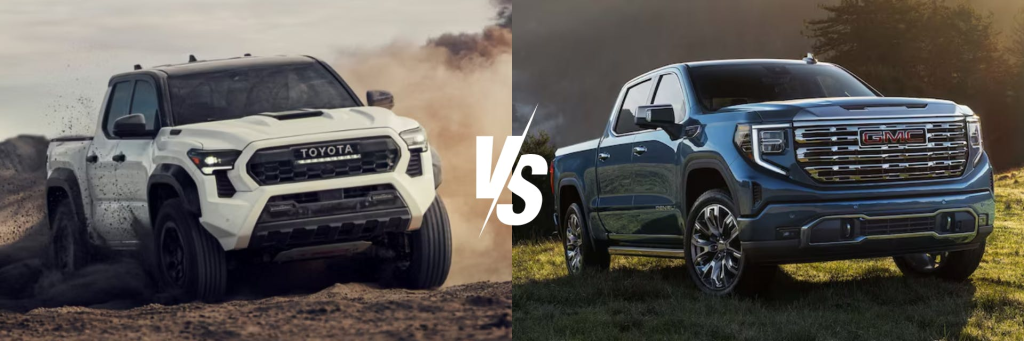
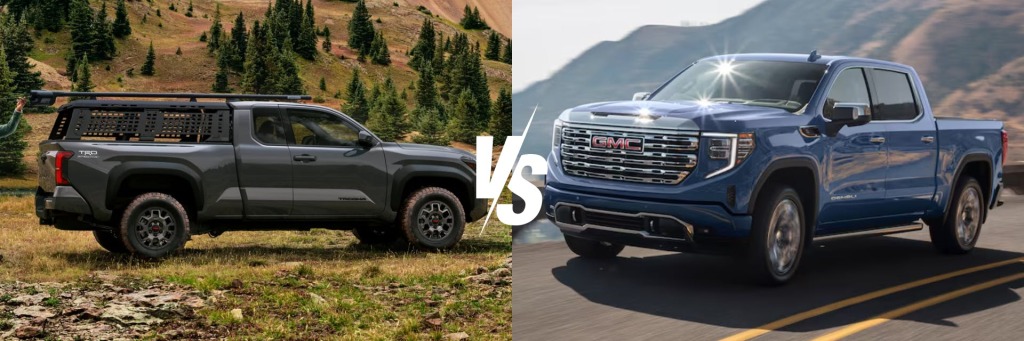
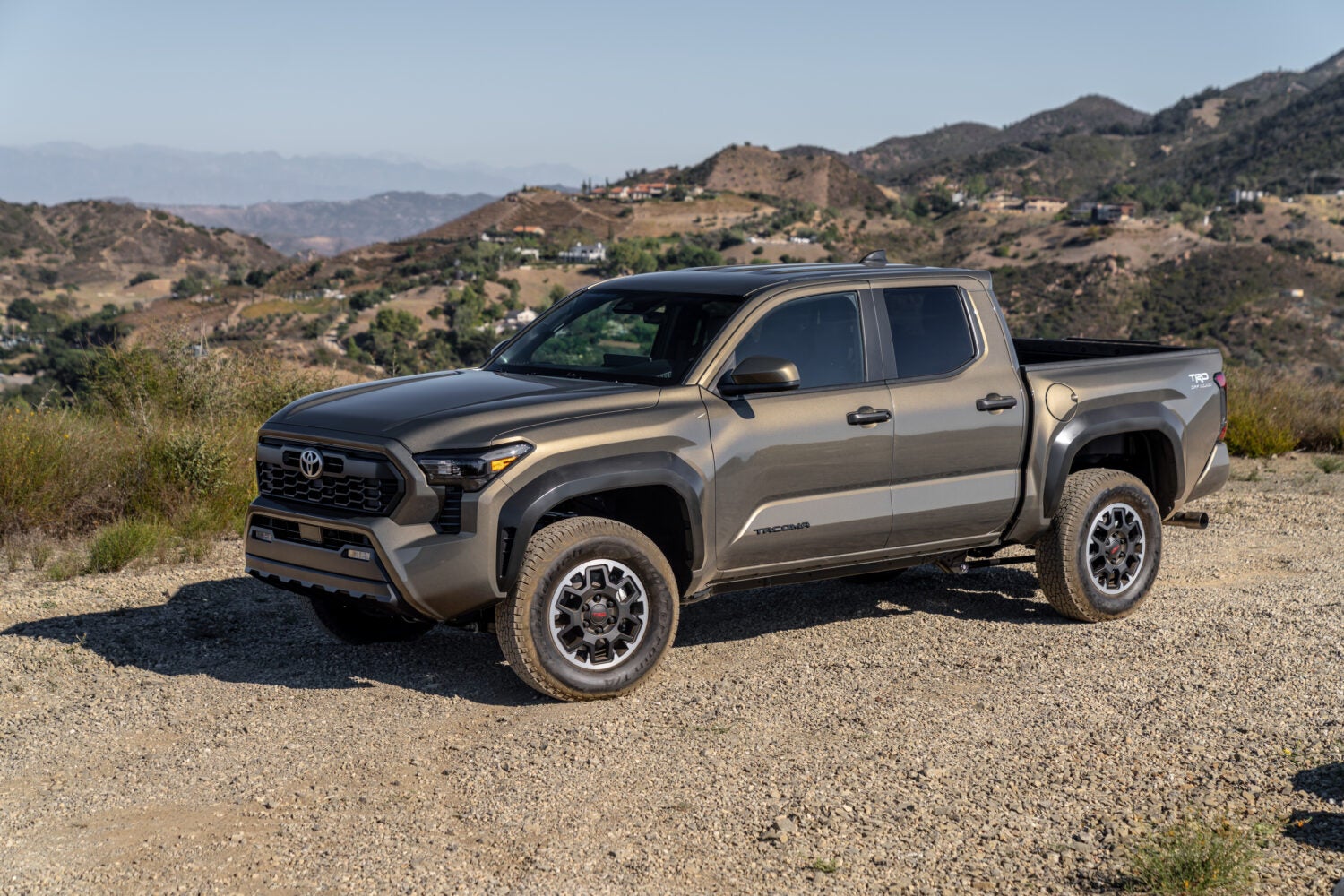
2024 Toyota Tacoma vs 2025 GMC Sierra

The 2024 Toyota Tacoma and GMC Sierra offer unique strengths in off-road capabilities, towing power, and advanced features. Here, we compare these two trucks to help you decide which best fits your needs, whether for adventure or daily drives.

Performance Comparison: Toyota Tacoma vs GMC Sierra

2024 Toyota Tacoma Vs 2025 Gmc Sierra

Both the Toyota Tacoma and GMC Sierra deliver reliable performance, but each truck has distinct advantages in power and fuel efficiency. Let's take a closer look at their key performance specifications.

Feature2024 Toyota Tacoma2025 GMC Sierra
Engine Optionsi-FORCE MAX Hybrid (326 HP, 465 lb.-ft. torque), i-FORCE V6 (278 HP, 317 lb.-ft. torque)TurboMax (310 HP, 430 lb.-ft. torque), 6.2L EcoTec3 V8 (420 HP, 460 lb.-ft. torque), 3.0L Duramax Diesel (305 HP, 495 lb.-ft. torque)
Transmission8-speed Automatic or 6-speed Manual10-speed Automatic
Fuel Economy (City/Highway)Up to 21/26 MPGUp to 23/29 MPG (select trims)

The Tacoma provides solid off-road power with its i-FORCE MAX hybrid engine, ideal for adventurous drives. Meanwhile, the Sierra's range of engine options offers more choice for drivers needing higher towing or fuel efficiency.

Towing and Payload: Toyota Tacoma vs GMC Sierra

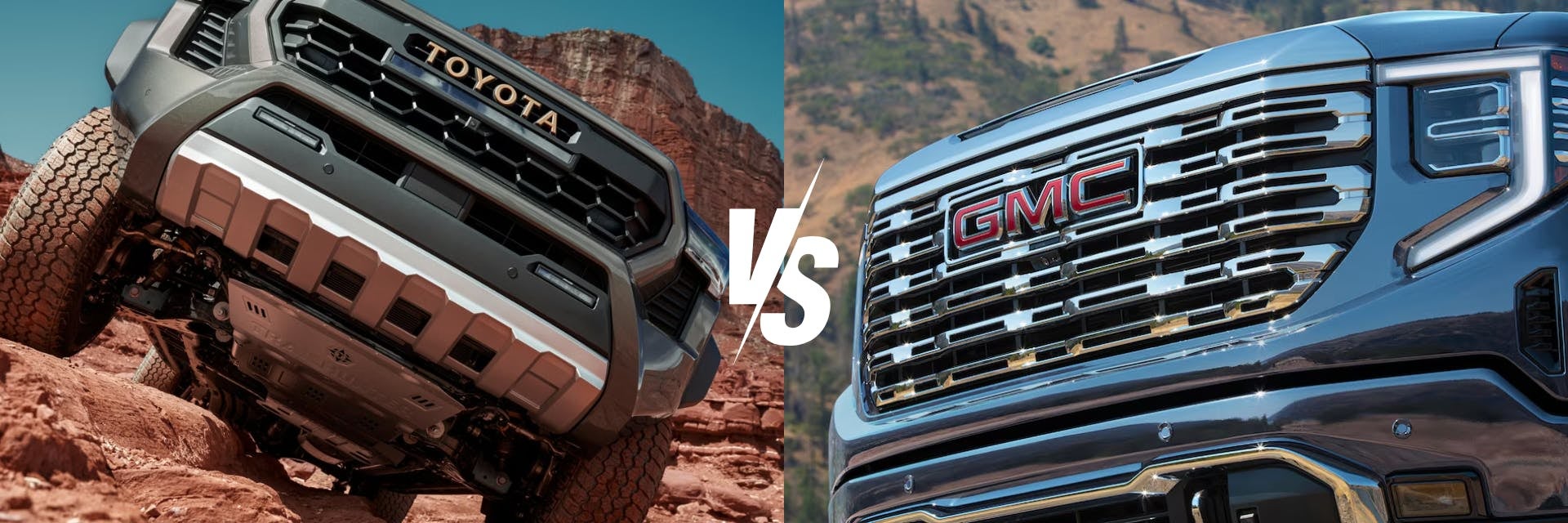
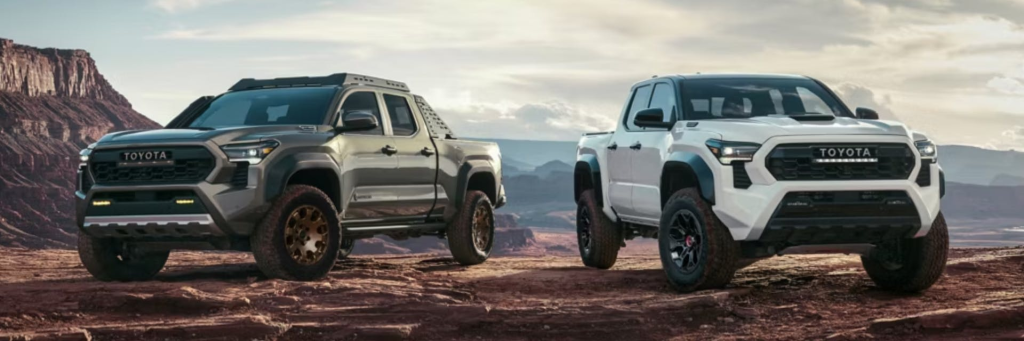
toyota Tacoma vs GMC Sierra

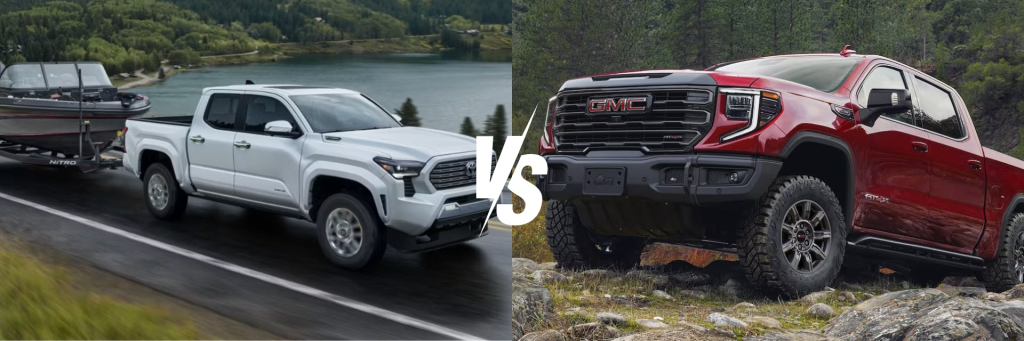
Towing capacity is a critical feature for many truck drivers. While the GMC Sierra offers higher maximum towing across its configurations, the Toyota Tacoma offers practical towing power for medium loads, with added off-road features for stability on rugged terrain.

Capability2024 Toyota Tacoma2025 GMC Sierra
Max Towing Capacity6,500 lbs.Up to 13,300 lbs.
Payload CapacityUp to 1,685 lbs.Up to 2,240 lbs.
Off-Road SupportTRD-tuned FOX® suspension, Multi-Terrain Monitor2″ Factory Lift, Rancho® Shocks (AT4 trim)

The Sierra's higher towing capacity is suitable for heavier loads, while the Tacoma offers exceptional off-road features for drivers who frequently navigate rough terrains or prioritize off-road adventures.

Technology and Interior Features: Toyota Tacoma vs GMC Sierra

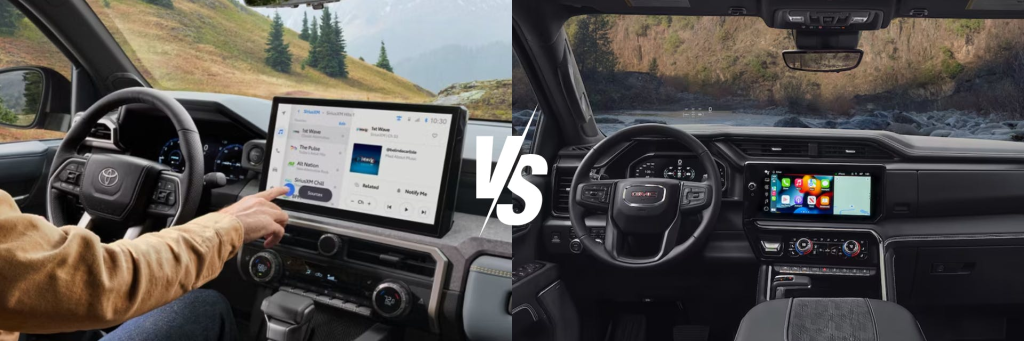
Toyota Tacoma vs GMC Sierra

The Toyota Tacoma and GMC Sierra include advanced technology options. The Sierra offers luxury-focused interior upgrades, while the Tacoma is optimized for functionality and rugged comfort.

Feature2024 Toyota Tacoma2025 GMC Sierra
Infotainment Display14-inch multimedia touchscreen13.4-inch touchscreen, 12.3-inch Driver Information Center
Audio SystemPremium Audio with JBL® speakers (TRD Pro)12-speaker Bose® Premium Audio (AT4X and Denali trims)
Advanced Camera SystemMulti-Terrain Monitor with Trailer Backup GuideSurround View with up to 14 camera views

The Sierra offers an upscale interior with Bose® sound and a wide array of camera views, while the Tacoma provides a rugged, functional interior equipped with essential off-road tech and convenience.

Safety Features: Toyota Tacoma vs GMC Sierra

Safety Features Toyota Tacoma vs GMC Sierra

Both the Toyota Tacoma and GMC Sierra offer comprehensive safety features, with each model including driver-assistance technology to enhance driver control and awareness.

Safety Feature2024 Toyota Tacoma2025 GMC Sierra
Blind Spot MonitorAvailable with Trailer AssistStandard on select trims
Lane Departure WarningStandardStandard
Adaptive Cruise ControlAvailableAvailable with Super Cruise on Denali trims

With driver-assist technologies like the Trailer Backup Guide on the Tacoma and the Super Cruise system on the Sierra, both models cater to safety-conscious drivers but in different ways.

Final Verdict: Toyota Tacoma or GMC Sierra?

Toyota Tacoma or GMC Sierra 2

The 2024 Toyota Tacoma stands out as the definitive off-road champion. With advanced features from Toyota Racing Development (TRD) and unmatched capability, the Tacoma is designed for those who seek adventure beyond the pavement. While the GMC Sierra shines with luxury and versatility, the Tacoma's rugged build, intuitive off-road technology, and legendary reliability make it the go-to choice for serious off-road enthusiasts. Visit Toyota of Katy to experience the Tacoma's trail-dominating performance and see why it's the undeniable leader in the off-road pickup category.

New Toyota | New Toyota Sedans | New Toyota Specials | New Tacoma Truck Research | Service Center | Finance Center

Toyota Tacoma Truck Dealership Serving:

Bridgeland | Brookshire | Rosenberg | Houston | Cypress | Sugar Land |Richmond |Hockley | Stafford | Waller | Bridgeland

Recommended Posts

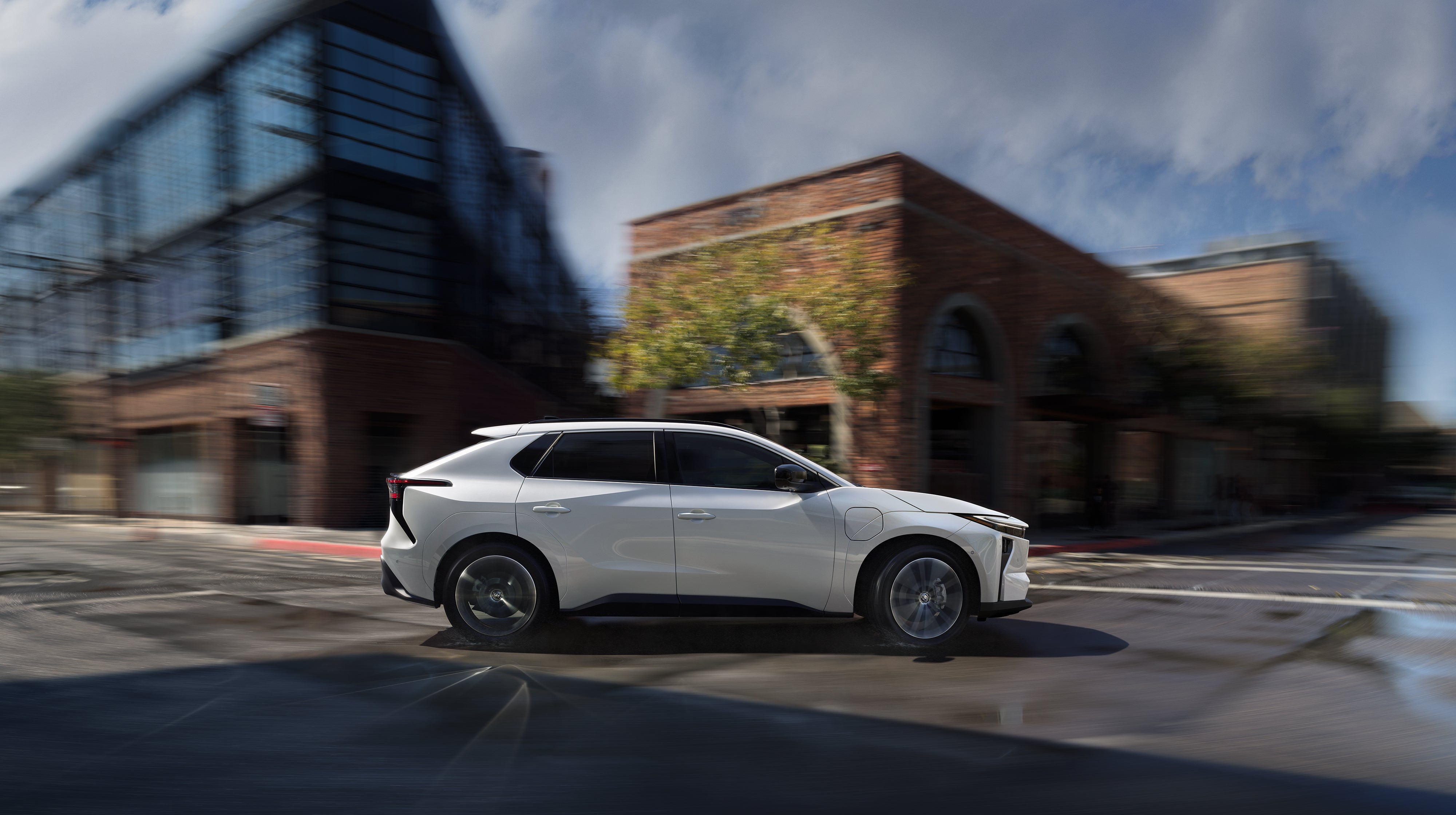
Toyota 2027 bZ Limited

Toyota bZ XLE vs. Limited: What's the Difference?

If you're shopping for an all-electric SUV in Katy, TX, the Toyota bZ is worth a closer look. With modern styling, a spacious interior, responsive electric performance, and advanced technology, this all-electric Toyota SUV offers a practical way to make the switch from gasoline to electric driving. But which trim is right for you? The Toyota bZ XLE vs. Limited comparison comes down to price, comfort, exterior styling, driver-assistance technology, and the features you want in your next SUV. Both trims offer all-electric driving and useful everyday amenities, while the Limited adds several premium upgrades. At Toyota of Katy, we're helping local drivers understand what separates these two bZ trims so they can make a more informed decision. Toyota bZ XLE vs. Limited: Key Differences at a Glance The following comparison covers the 2026 Toyota bZ lineup. Features, pricing, and availability can vary by model year and configuration. Feature Toyota bZ XLE Toyota bZ Limited Position in lineup Entry trim Premium trim Drivetrain FWD, FWD Plus, or AWD, depending on configuration FWD or AWD Wheels 18-inch alloy wheels with covers 20-inch alloy wheels Front seats Heated, fabric/SofTex-trimmed Heated and ventilated, SofTex-trimmed Driver's seat 8-way power adjustment 8-way power adjustment with lumbar support Front passenger seat 6-way adjustment 8-way power adjustment Infotainment 14-inch touchscreen 14-inch touchscreen Driver-assistance technology Toyota Safety Sense 3.0 and standard safety features Additional advanced driving and parking assistance features Premium audio Standard six-speaker system Optional nine-speaker JBL Premium Audio Panoramic glass roof Available Standard The biggest distinction is that the XLE delivers a well-equipped electric SUV with a strong set of standard features, while the Limited focuses on enhanced comfort, upgraded styling, and additional driver-assistance technology. 1. Price and Overall Value For many shoppers, the first question is whether the Toyota bZ Limited's extra features justify its higher price. For the 2026 model year, Toyota lists the following starting MSRPs: Toyota bZ XLE: $34,900 Toyota bZ Limited: $43,300 That represents an $8,400 difference in base MSRP before applicable taxes, fees, incentives, and dealer-installed options. Actual vehicle prices can vary based on drivetrain, configuration, and available inventory. The XLE makes a compelling case for drivers who want an electric SUV without paying for every available luxury upgrade. Its standard equipment includes a large touchscreen, heated front seats, a heated steering wheel, wireless smartphone connectivity, and a power liftgate. The Limited is aimed at shoppers who want more premium amenities in their daily driving experience. Its upgraded seating, larger wheels, and additional convenience technology may make the higher price worthwhile if those features are important to you. When comparing your options at Toyota of Katy, consider the complete vehicle price and equipment of the specific model you're interested in rather than relying on trim-level starting prices alone. 2. Electric Range, Performance, and Drivetrain Both the Toyota bZ XLE and Limited use an all-electric powertrain, so neither requires gasoline for everyday driving. However, the range and performance you get depend on the trim's drivetrain and battery configuration. Toyota bZ XLE The XLE offers front-wheel-drive and all-wheel-drive configurations, including an XLE FWD Plus model with an extended advertised driving range. This variety gives shoppers flexibility when balancing range, traction, and budget. Toyota bZ Limited The Limited is available with front-wheel drive or all-wheel drive, combining electric performance with premium amenities. All-wheel-drive models use two electric motors, while front-wheel-drive models use a single electric motor. The 2026 Toyota bZ offers up to 314 miles of manufacturer-estimated driving range on a full charge for the XLE FWD Plus. The XLE AWD has an EPA-estimated range rating of 288 miles, while Toyota lists an estimated 299 miles for the Limited in its trim overview. All-wheel-drive models feature up to 338 combined system net horsepower. Front-wheel-drive models produce up to 221 horsepower. For Katy drivers commuting along I-10, traveling around the Houston area, or planning weekend trips, the right choice depends on your typical mileage, charging routine, and preference for front-wheel or all-wheel drive. Remember that real-world driving range varies with speed, weather, climate-control use, terrain, and driving habits. 3. Interior Comfort and Seating Interior comfort is one of the clearest differences between the XLE and Limited. The Toyota bZ XLE includes fabric and SofTex-trimmed seating, heated front seats, and an eight-way power-adjustable driver's seat. These features make it a practical option for drivers who want everyday comfort without moving into a premium trim. The Toyota bZ Limited upgrades the cabin with fully SofTex-trimmed seats, heated and ventilated front seats, and an eight-way power-adjustable front passenger seat. The driver's seat also adds lumbar support. Ventilated front seats can be especially appealing during hot Texas summers, when keeping the cabin comfortable is a priority. Both trims offer a spacious cabin with 42.1 inches of front legroom and 35.3 inches of rear legroom. The bZ also offers 27.7 cubic feet of cargo space behind the rear seats, providing room for groceries, luggage, and everyday essentials. Which trim is better for comfort? The XLE covers the essentials, but the Limited is the stronger choice if you want more seating adjustments and front-seat ventilation. 4. Exterior Styling and Wheel Design Although the two trims share the Toyota bZ's distinctive electric-SUV design, their exterior details help set them apart. XLE: Practical, Modern Styling The XLE comes with 18-inch black-and-silver multi-spoke alloy wheels with covers, LED lighting, and the bZ's sleek exterior design. Its appearance suits drivers who prefer a clean, contemporary look. Limited: A More Premium Appearance The Limited upgrades to 20-inch black multi-spoke alloy wheels and multi-LED headlights. These details give the SUV a more upscale look without changing its core electric-SUV character. The Limited also includes a panoramic fixed-glass moonroof with a power sunshade, which is available as an option on the XLE. If exterior appearance and a panoramic roof are high on your wish list, the Limited offers a more complete package. If you'd rather prioritize value, the XLE still provides modern styling and distinctive design. 5. Technology and Infotainment You don't have to choose the Limited to get a modern technology experience. Both trims come with a 14-inch Toyota Audio Multimedia touchscreen, wireless Apple CarPlay and Android Auto compatibility, and dual wireless smartphone chargers. The XLE also includes six speakers, four USB-C charging ports, and customizable ambient lighting. These features help keep the cabin connected and convenient for everyday commutes. The Limited builds on that foundation with additional premium and driver-assistance options. Available nine-speaker JBL Premium Audio, including a subwoofer and amplifier, is a notable upgrade for drivers who enjoy a richer sound system. The key takeaway is that both trims provide a large central display and essential smartphone connectivity. The Limited is worth considering if you want to take the in-cabin experience to the next level. 6. Safety and Driver-Assistance Features Safety technology is important whether you're navigating busy Katy intersections, merging onto the freeway, or parking in a crowded shopping center. Both the XLE and Limited include Toyota Safety Sense 3.0 and a range of standard safety and driver-assistance features. Depending on the system, these technologies can help with collision avoidance, lane awareness, and adaptive cruise control. The Limited adds several convenience-focused technologies that go beyond the XLE's standard equipment, including: Lane Change Assist: Helps support lane changes when the system's operating conditions are met. Traffic Jam Assist: Provides driving assistance in certain traffic conditions when eligibility requirements are satisfied. Front Cross-Traffic Alert: Helps detect approaching vehicles from the sides at certain intersections or when pulling forward from a parking space. Advanced Park: Helps the driver maneuver into and out of selected parking spaces. Some features require an active Remote Connect subscription and have additional operating requirements. Driver-assistance systems do not replace attentive driving. For drivers who frequently encounter heavy traffic or tight parking spaces, these additional technologies may be an important reason to consider the Limited. 7. Charging the Toyota bZ at Home and on the Road Charging convenience is another consideration when deciding between the Toyota bZ XLE and Limited. Both trims support Level 1 and Level 2 home charging and compatible DC fast charging. The 2026 bZ also features a North American Charging System (NACS) charging port, providing access to compatible charging stations across the country. Level 1 charging: Uses a standard household outlet and can work for drivers with relatively low daily mileage who have plenty of time to charge. Level 2 charging: Uses a 240-volt power source and is generally better suited for overnight home charging. DC fast charging: Can replenish the battery much more quickly at compatible public charging stations. Toyota estimates that charging from 10% to 80% takes approximately 30 minutes under ideal conditions. Charging times vary based on battery temperature, charger output, battery state of charge, and other factors. Neither trim automatically makes more sense for charging simply because of its equipment level. Your daily mileage, home charging setup, and access to public chargers should guide your decision. Which Toyota bZ Trim Is Right for You? The best choice depends on which features matter most to you and how much you're willing to spend. Choose the Toyota bZ XLE If... You want a lower starting price. Heated front seats and a heated steering wheel meet your comfort needs. You want a large touchscreen and wireless smartphone connectivity. You prefer to prioritize electric range and value, including the XLE FWD Plus configuration. Choose the Toyota bZ Limited If... You want heated and ventilated front seats. You prefer larger 20-inch wheels and upgraded headlights. A panoramic glass roof is on your must-have list. You value additional driver-assistance features and premium audio options. Explore the Toyota bZ at Toyota of Katy Comparing the Toyota bZ XLE vs. Limited is a great starting point for finding an electric SUV that fits your daily routine. The XLE offers a strong combination of technology, comfort, and electric capability, while the Limited adds premium seating, distinctive exterior details, and additional convenience features. The next step is to compare the available configurations and determine which one best fits your driving habits, charging needs, and budget. At Toyota of Katy, located on Katy Freeway in Katy, TX, you can explore available Toyota bZ models and get help comparing trims, features, and pricing. Ready to explore electric driving? Browse the Toyota bZ inventory at Toyota of Katy or contact our team to learn more about available models and schedule a test drive. Specifications and pricing are based on published information for the 2026 Toyota bZ and may differ for 2027 models. Confirm the equipment, pricing, and availability of the specific vehicle before purchasing.

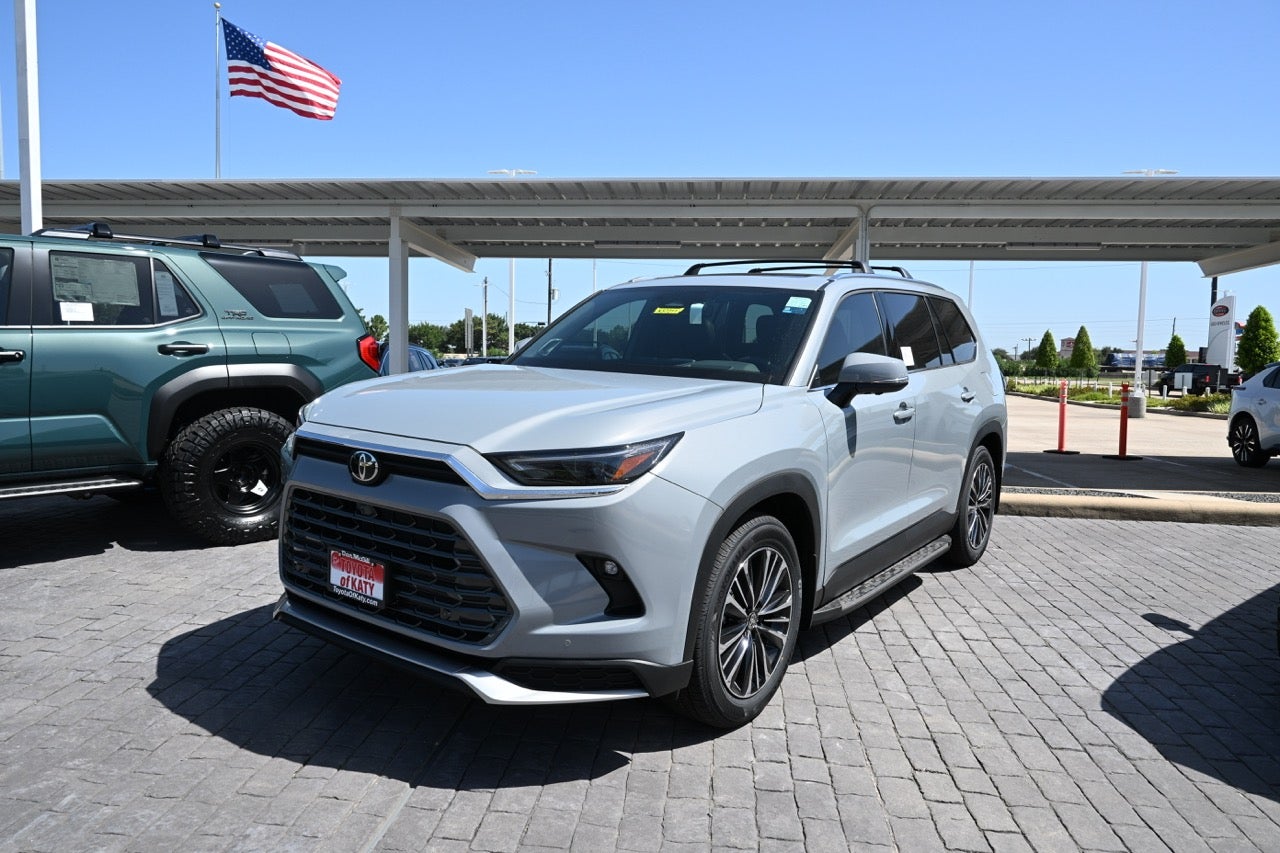
2026 Toyota Grand Highlander at Toyota of Katy

What's the Difference Between the Toyota Grand Highlander XLE and Platinum?

Whether you're hauling the family down I-10 to San Antonio or loading up for a weekend in the Hill Country, your vehicle needs to handle it all without compromise. The Toyota Grand Highlander has become a serious contender for families across Katy and the Greater Houston area, and the debate often comes down to two trims: the XLE and the Platinum. Each offers something compelling, but they suit different kinds of drivers. If you're weighing the Grand Highlander XLE vs. Platinum for your next road-trip vehicle, this guide breaks down what actually sets them apart. Explore our Toyota dealership in Katy and browse our Grand Highlander inventory once you know which trim fits. Why Texas Families Debate Grand Highlander XLE vs. Platinum The XLE earns respect as a practical, well-equipped option that doesn't stretch the budget too far. The Platinum earns attention for a cabin experience that feels closer to a luxury vehicle than a family hauler. Long highway stretches, intense summer heat, sudden rainstorms, and occasional trailer towing all put real demands on a three-row SUV, and that's where meaningful differences between the two trims start to show. Grand Highlander Trim Lineup: Where XLE and Platinum Stand Toyota's 2026 Grand Highlander lineup has four trims: LE, XLE, Limited, and Platinum, with each step adding features, comfort, and technology. The XLE is the entry point for buyers who want a genuinely well-equipped Grand Highlander, offering a strong feature set without padding the price with extras you may not need. The Platinum tops the lineup, built for buyers who want the most refined Grand Highlander experience, with premium materials and more advanced technology. Pricing shifts often and varies by dealer, but as a general guide, the XLE has an MSRP starting near $45,030, while the Platinum starts near $55,445. That's a meaningful gap, and whether it's worth it depends entirely on what you prioritize. Grand Highlander XLE: Comfort and Capability for Everyday Trips The XLE is where most families start when they discover just how capable the Grand Highlander actually is. It offers three rows of genuinely usable space, a comfortable ride, and enough technology to keep everyone connected. For daily driving around Katy, it checks every box without overcomplicating the decision. Standard Tech and Family-Friendly Features The XLE comes with a 12.3-inch touchscreen, wireless Apple CarPlay® and Android Auto™, Digital Key, and heated front seats trimmed in synthetic leather. Three-zone automatic climate control helps manage cabin temperature on hot Texas days, and second-row sunshades keep the sun off backseat passengers on long drives. A wireless charging pad and power liftgate round out the everyday-convenience list, and seating for up to eight gives families room to spread out. Powertrain and Towing for Highway Cruising The Grand Highlander XLE runs on Toyota's 2.4-liter turbocharged four-cylinder engine, producing 265 horsepower and 310 lb-ft of torque, and is paired with an eight-speed automatic transmission. That's confident merging and passing power for Texas interstates, even with a full load of passengers and luggage. Towing capacity reaches up to 5,000 pounds when properly equipped. The XLE comes standard with FWD, with AWD available as an approximately $1,600 option, worth considering if you're planning trips through unpredictable Gulf Coast weather. Fuel economy for the FWD XLE is rated at 21 mpg city, 28 mpg highway, and 24 mpg combined. Grand Highlander Platinum: Premium Comfort for Long-Haul Road Trips The Platinum keeps everything that makes the XLE practical and capable, then layers in luxury materials and a more polished driving experience that's especially noticeable over long distances. If your family does multi-day road trips across Texas, the Platinum's upgrades shift from nice-to-have to genuinely worthwhile. Luxury Materials and Cabin Technology Step inside the Platinum, and the difference is immediate. Genuine leather seating replaces the XLE's synthetic upholstery, and the seats are heated and ventilated front and rear, a real advantage on scorching Texas summer days. A panoramic power roof adds an airy feel while still shading the cabin, and a 10-inch Head-Up Display puts speed and navigation directly in the driver's line of sight. A digital rearview mirror and Panoramic View Monitor give a clearer, wider look around the vehicle, particularly useful when navigating parking lots or towing. Advanced Safety and Driver-Assist Features The Platinum comes standard with AWD, which pairs well with sudden downpours common along the Gulf Coast, along with the added visibility of the Panoramic View Monitor and digital rearview mirror. Fuel economy for the AWD Platinum comes in at 20 mpg city, 26 mpg highway, and 22 mpg combined, a reasonable trade-off for the extra traction and confidence. XLE vs. Platinum: Side-by-Side for Texas Road Trips Both trims share the same 2.4-liter turbocharged engine, 265 horsepower, and 310 lb-ft of torque, an eight-speed automatic transmission, seating for eight, and a 5,000-pound towing capacity. The table below lays out where they part ways. Spec Grand Highlander XLE Grand Highlander Platinum Drivetrain FWD standard; AWD optional for approximately $1,600 AWD standard Fuel Economy (City/Highway/Combined) 21/28/24 mpg 20/26/22 mpg Seating Material Synthetic leather Genuine leather Key Comfort Features Heated front seats, second-row sunshades Heated and ventilated front and rear seats, panoramic power roof Key Technology 12.3-inch touchscreen, Digital Key, wireless charging 10-inch Head-Up Display, digital rearview mirror, Panoramic View Monitor Approximate Starting MSRP $45,030 $55,445 If you'd like to see these differences in person, contact our team to schedule a test drive at Toyota of Katy. Interior Space and Ride Comfort Both trims share the Grand Highlander's generous passenger volume and cargo space, with identical seating for eight and near-identical legroom throughout all three rows. Where the Platinum pulls ahead is comfort over distance: genuine leather, ventilated seats, and the panoramic roof's shade make a noticeable difference on a six-hour drive to the Hill Country or Gulf Coast. Which Grand Highlander Trim Fits Your Texas Lifestyle? The right answer comes down to how you actually use your SUV, not which trim wins on paper. Best for Budget-Conscious Buyers The XLE offers outstanding value for families who want a capable, well-equipped three-row SUV without stretching into Platinum territory. The spacious cabin, strong powertrain, and full Toyota Safety Sense suite come fully intact, so budget-focused buyers aren't sacrificing the essentials. Best for Multi-Day Family Road Trips The Platinum earns its price premium most clearly for families who regularly take extended road trips. Ventilated seats, standard AWD for sudden weather changes, and the added comfort features can make a difference on a drive to San Antonio, Big Bend, or the Florida coast. Best for Frequent Highway Drivers If your week involves regular highway commuting through Katy and West Houston, the XLE offers a strong balance of comfort, safety tech, and value without paying for features you may not use daily. Test Drive the Grand Highlander XLE or Platinum at Toyota of Katy Reading about these two trims only gets you so far. Sitting in the Platinum's ventilated seats, checking out the Head-Up Display, and experiencing the AWD system firsthand gives you information no comparison article can replicate. Toyota of Katy has served the Katy community for more than 20 years, and our team can walk you through current inventory, available packages, and financing options that fit your budget. Schedule Your Visit Explore our Grand Highlander inventory in Katy to see the current availability of the XLE and Platinum, then contact our team to schedule a test drive. It's a practical way to compare the trims and find the right fit for your family.

A bronze oxide 2026 Toyota Tacoma TRD Off Road on a gravel road

2026 Toyota Tacoma vs Tundra: Key Differences

Picking between the Tacoma and Tundra usually comes down to one question: do you need a truck that fits easily into daily life around Katy, or one built to move serious weight? Both are capable Toyota trucks, but they solve different problems. This guide compares their size, towing, power, fuel economy, and pricing so you can choose the truck that fits how you actually drive, work, and play. Tacoma vs Tundra: Which Toyota Truck Matches Your Needs in Katy? The Tacoma makes sense if you want a mid-size truck that's easier to maneuver and more efficient for everyday driving. The Tundra makes more sense when heavy towing, additional cabin space, or a larger bed is part of your routine. Drivers commuting through Katy or the Energy Corridor may appreciate the Tacoma's smaller footprint when parking and navigating busy streets. Families towing boats to Lake Conroe or workers regularly moving equipment may get more value from the Tundra's additional capacity. The key is matching the truck to what you actually need rather than simply choosing the larger model. If you want to compare current availability while you read, browse our new Toyota inventory at Toyota of Katy. Size and Dimensions: Comparing the Tacoma and Tundra The Tundra is a full-size pickup, while the Tacoma is a mid-size truck. That distinction affects more than appearance. It can change how easily the truck fits into a garage, how comfortable the cabin feels with passengers, and how much room you have for cargo. Exterior Size and Maneuverability Around Katy The Tacoma's smaller footprint gives it an advantage when maneuverability matters. It's easier to work into tighter parking spaces and can feel less cumbersome in crowded shopping centers or older parts of town. The Tundra is wider and substantially larger overall. That added size can make parking and tight turns require more attention, but it also contributes to the truck's larger cabin, greater cargo capacity, and heavier-duty capability. For drivers who spend more time towing or hauling than squeezing into tight parking spaces, that tradeoff may be worthwhile. Cabin Space, Legroom, and Bed Configurations The Tundra offers more interior space, making it the better choice if you regularly carry adults in the second row or take longer family trips. The Tacoma can still accommodate passengers comfortably, but its mid-size dimensions make it easier to live with if maximum cabin space isn't a priority. Bed configurations also differ. The Tacoma offers 5-foot and 6-foot bed options, while the Tundra is available with 5.5-foot, 6.5-foot, and 8.1-foot beds. That extra bed capacity can matter when you're regularly hauling lumber, landscaping equipment, furniture, or other bulky cargo. In practical terms, the Tacoma gives you a more manageable truck for everyday driving, while the Tundra gives you more room to work with when passenger and cargo demands increase. Towing and Payload: How Much Can Each Truck Handle? This is where the difference between the two trucks becomes most obvious. The 2026 Tacoma can tow up to 6,500 pounds and carry up to 1,705 pounds of payload, while the 2026 Tundra reaches up to 12,000 pounds of towing capacity. Spec Tacoma Tundra Powertrain 2.4L turbo or available i-FORCE MAX hybrid i-FORCE twin-turbo V6 or available i-FORCE MAX hybrid Max Horsepower 326 hp with i-FORCE MAX 437 hp with i-FORCE MAX Max Torque 465 lb-ft with i-FORCE MAX 583 lb-ft with i-FORCE MAX Max Towing Up to 6,500 lbs. Up to 12,000 lbs. Max Payload Up to 1,705 lbs. Up to 1,850 lbs.* Bed Lengths 5 ft. / 6 ft. 5.5 ft. / 6.5 ft. / 8.1 ft. Transmission 8-speed automatic or available 6-speed manual 10-speed automatic *Maximum payload varies by configuration. Always verify the specific vehicle's published ratings before towing or hauling. Max Towing Capacity by Powertrain The Tundra has a substantial advantage when towing is a major part of your routine. It's available with a 12,000-pound maximum, which gives it significantly more capacity for larger boats, campers, trailers, and work equipment. The available i-FORCE MAX hybrid produces 437 horsepower and 583 lb-ft of torque, giving the Tundra strong low-end pulling power. The Tacoma's 6,500-pound maximum is much lower, but that doesn't make it inadequate for lighter towing. A smaller boat, utility trailer, recreational equipment, or weekend project may fit comfortably within the Tacoma's capabilities. The important question is how much you tow and how frequently you do it. Payload Ratings for Work and Recreation Payload is closer between the two trucks than towing capacity, but the Tundra still has the edge. If you're routinely carrying heavy tools, materials, equipment, or other cargo in the bed, the Tundra gives you more capacity to work with. For occasional hauling, however, the Tacoma's payload rating is substantial for a mid-size pickup. If most of your truck use involves commuting during the week and smaller projects on weekends, you may not need the Tundra's additional capability. Powertrain, Performance, and Fuel Economy The Tundra produces more power, while the Tacoma's smaller size and available hybrid powertrain make it appealing for drivers who don't need full-size truck capability every day. Engine Options and Horsepower Compared The Tacoma uses a 2.4-liter turbocharged four-cylinder engine producing up to 278 horsepower and 317 lb-ft of torque. The available i-FORCE MAX hybrid increases output to 326 horsepower and 465 lb-ft of torque. Toyota also offers a six-speed manual transmission on select Tacoma configurations. The Tundra starts with a twin-turbo V6 producing up to 389 horsepower and 479 lb-ft of torque. The available i-FORCE MAX hybrid increases output to 437 horsepower and 583 lb-ft. Both Tundra powertrains use a 10-speed automatic transmission. That difference is noticeable if you're towing or carrying substantial weight. For drivers who primarily commute and use their truck for everyday errands and lighter jobs, the Tacoma's powertrain offers plenty of capability without the need to step up to a full-size pickup. Fuel Efficiency for Katy Commuters and Highway Drivers The Tacoma generally has the fuel-economy advantage, particularly when compared with a full-size Tundra. The 2026 Tacoma's available i-FORCE MAX hybrid is rated at up to 23 mpg combined, while certain gas configurations reach 26 mpg on the highway. The 2026 Tundra's gas models are rated at 18 mpg city and 23 mpg highway in their most efficient configurations, while available i-FORCE MAX models improve efficiency compared with the standard gas powertrain. For someone driving the Katy Freeway every day, fuel economy can become a meaningful ownership consideration. If your driving is mostly commuting with occasional towing, the Tacoma can make more sense. If you're regularly pulling a trailer or carrying heavy loads, the Tundra's additional capability may be worth the tradeoff. Everyday Usability: Commuting, Hauling, and Weekend Trips The Tacoma is the easier truck to justify when everyday driving is the priority. Its smaller dimensions can make parking and maneuvering less stressful, while its fuel economy is better suited to a commute-heavy routine. It can still handle weekend trips, home-improvement projects, recreational gear, and lighter towing. The Tundra becomes more compelling when your truck needs to do more than commute. Its larger cabin is better suited to families and passengers, while its towing and bed capacity provide more flexibility when you're hauling substantial loads. One thing we hear from truck shoppers is that the decision isn't always about which truck is more capable. It's about whether you will actually use that extra capability. If you don't regularly tow or haul heavy loads, the Tacoma may give you everything you need without adding the size of a full-size pickup. Off-Road and Work-Ready Capability Both trucks offer serious off-road equipment, but they approach the job differently. The Tacoma's smaller size makes it particularly well-suited to tight trails, while the Tundra combines off-road equipment with full-size towing and hauling capability. The Tacoma TRD Off-Road offers equipment such as Bilstein shocks, Crawl Control, Multi-Terrain Select, and an available electronically locking rear differential. The TRD Pro and Trailhunter take things further with specialized suspension and off-road hardware. Toyota's 2026 Tacoma Trailhunter, for example, uses Old Man Emu 2.5-inch forged monotube shocks and 33-inch all-terrain tires. The Tundra also offers TRD Off-Road and TRD Pro configurations with equipment designed for more demanding terrain. The TRD Pro combines that off-road capability with substantially greater towing capacity than the Tacoma, making it a better fit for someone who wants a single truck to handle both serious trail use and heavy towing. Pricing and Long-Term Value Considerations The Tacoma has a lower starting price, with the 2026 model beginning at $32,545 before destination and other charges. The 2026 Tundra starts at $41,260. That price difference reflects more than the badge. The Tundra is a larger, more powerful full-size truck with substantially greater towing capacity and additional interior and cargo space. The Tacoma costs less to get into and may be the better value if you don't need those extra capabilities. In other words, don't automatically assume the more expensive truck is the better choice. The right truck is the one whose capability matches your actual needs. Which Toyota Truck Fits Your Katy Lifestyle? If you're commuting from Katy to the Energy Corridor most weekdays, handling errands around town, and occasionally towing a smaller trailer for weekend recreation, the Tacoma is likely the better fit. It's easier to maneuver, more efficient, and still offers meaningful towing and off-road capability. If you're regularly towing a larger boat or camper, hauling equipment, carrying a full crew, or simply want the additional space of a full-size pickup, the Tundra makes more sense. Its higher towing capacity, larger cabin, and bigger bed give you considerably more room to work with. Choose the Tacoma for Daily Driving and Versatility The Tacoma is a strong choice for drivers who want a truck that can handle the commute, errands, weekend projects, and recreational trips without the size of a full-size pickup. It's particularly appealing if maneuverability and fuel economy matter as much as towing capacity. Choose the Tundra for Maximum Power and Space The Tundra is the better choice when towing, hauling, passenger space, or bed capacity are high on your list. Its larger dimensions come with a substantial increase in capability, making the additional size easier to justify for drivers who regularly put their truck to work. If you're leaning toward the Tundra, browse Tundra inventory at Toyota of Katy to see current trim availability. You can also explore financing options to compare what the two trucks could look like within your budget. Test Drive the Tacoma or Tundra at Toyota of Katy Numbers on a spec sheet only tell part of the story. Driving both trucks is the easiest way to understand the difference in size, seating position, ride, visibility, and overall feel. We're located at 21555 Katy Fwy, Katy, TX 77450, and our team can walk you through the differences between the Tacoma and Tundra based on how you plan to use your truck. If you're ready to compare them side by side, contact Toyota of Katy online to schedule a test drive, or stop by to see the Tacoma and Tundra lineups in person.